Are You Ready for Two 90-Minute Locks in a Full MHT-CET PCM Mock?
Choose the answer closest to your current preparation. Higher points always mean more risk that a full-length mock will measure unfinished preparation rather than give you a useful test-day rehearsal.
Question 1 of 6
How complete is your exam-relevant PCM coverage?
Pick an answer to continue. Your result appears after question 6.

By Rahul Jeewani, Founder · Updated 27 Sept 2026
In brief
MHT-CET PCM is not one flexible three-hour sitting. The 2026 official format uses two fixed 90-minute blocks, so this six-question assessment checks whether your coverage, timed practice, error review and board workload support a useful full-length mock.
What this assessment measures
A full-length mock is most useful when it reveals a test-taking pattern you can act on. This assessment checks six signals: PCM syllabus coverage, readiness for the fixed two-block timing, recent timed accuracy, error-review habits, board-study capacity and familiarity with the computer-based format.
The Maharashtra State CET Cell's 2026 syllabus and marking scheme assigns approximately 80% of question-paper weightage to Std XII and 20% to Std XI. The 2026 information brochure sets PCM at 150 questions in 180 minutes, with no negative marking.
Why one sitting has two different pressures
Physics and Chemistry run first for 90 minutes, then that section is auto-submitted before Mathematics opens for the remaining 90 minutes. A student who can complete isolated chapter tests may still need practice sustaining both blocks in sequence.
PCM timing is split before Mathematics begins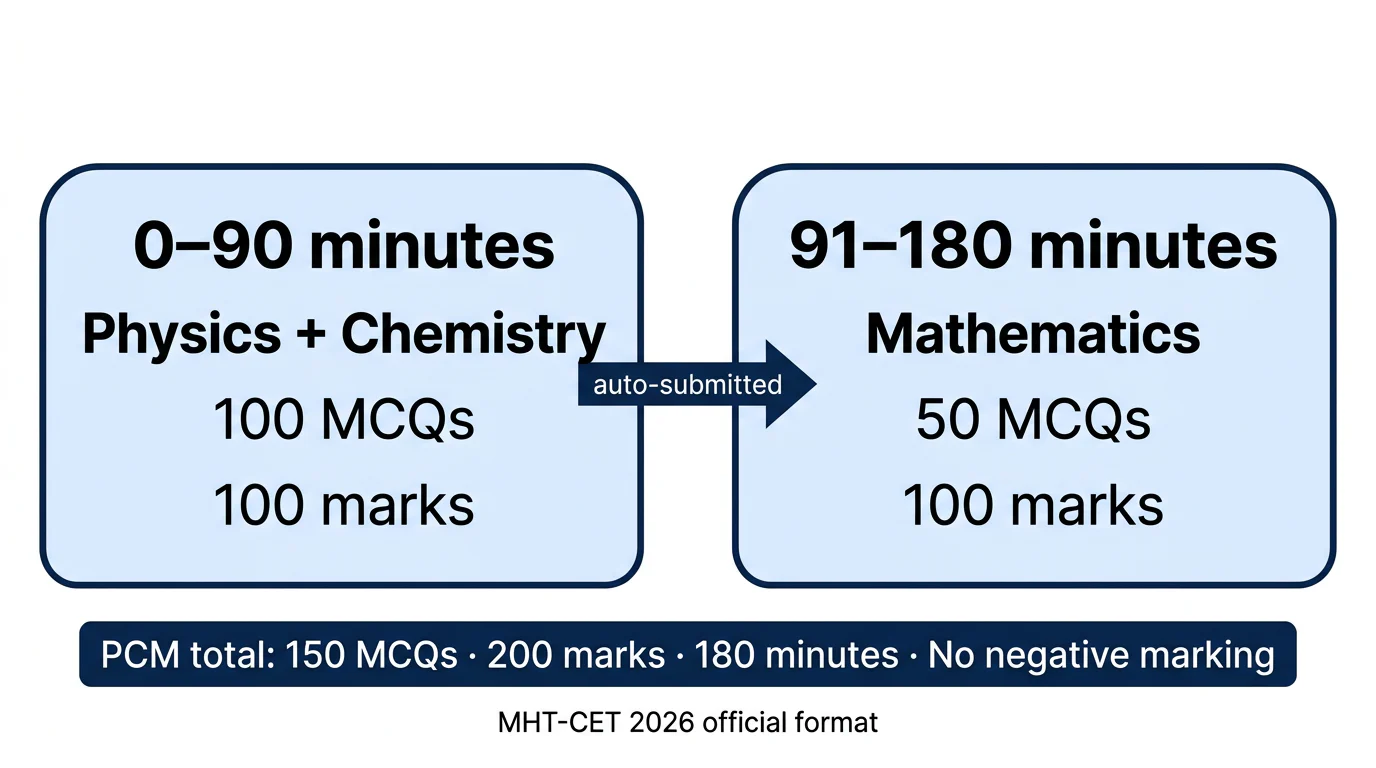
The assessment is not a percentile or admission predictor. It is a decision tool for choosing between a full mock, a shorter timed test or a period of coverage and review first.
Read your score as a risk signal
Each answer carries 0, 1 or 2 risk points. Add the six answers for a total from 0 to 11. The equal-width score bands are 0–3, 4–7 and 8–11.
If your next step is a full mock, use the official MHT-CET mock test guide for the interface and follow it with a PCM error log. If your score points to preparation gaps, start with the Physics-first PCM plan or a 180-minute test-series review plan.
Correct-answer feedback matters after practice. A 2021 Psychological Bulletin meta-analysis covering 48,478 students across 222 studies found that the effect of quizzing varied with factors including corrective feedback and test repetition. That is why the assessment asks what happens after a timed set, not only whether you take one.
What this assessment asks
6 questions. Each answer carries points; your total picks the result band below.
01How complete is your exam-relevant PCM coverage?
- I have substantial gaps in one subject or in included Class XI topics.
- I have covered the Class XII syllabus across PCM and the included Class XI topics.
- I have large unfinished portions across more than one PCM subject.
02How ready are you for the fixed two-block timing?
- I have not yet completed a timed 90-minute block under quiet test conditions.
- I can work uninterrupted through Physics and Chemistry for 90 minutes, then Mathematics for another 90 minutes.
- I can complete one 90-minute block, but I have not yet rehearsed both blocks in sequence.
03What does your recent timed practice show about accuracy?
- I notice some errors after timed practice, but I cannot yet name a consistent cause.
- I do not yet take timed PCM practice or check why answers went wrong.
- I can identify which answers were wrong or slow and the reason for each pattern.
04What happens after you finish a timed set?
- I usually move on after seeing the score.
- I log errors or slow questions, review solutions and schedule targeted revision.
- I look at solutions, but I do not consistently record or revisit error patterns.
05Can your current board workload make room for a full mock and review?
- Only sometimes. A full mock would be possible, but it would compete with planned board tasks.
- No. A full mock would currently displace urgent board preparation or revision.
- Yes. I can protect one 180-minute sitting and time afterwards to review it without dropping urgent board work.
06How familiar are you with the MHT-CET PCM test format?
- I know the broad pattern, but I need to practise or understand the timed two-block format before relying on a full mock.
- I understand the computer-based format, four-option MCQs, no negative marking and the two fixed 90-minute blocks.
How to read your score
| Score | Result | What it means |
|---|---|---|
| 0–3 | 0–3: Use your first full mock as a diagnostic | Your answers show that a full-length mock can now reveal useful information about pacing, accuracy and stamina. Take one in a quiet 180-minute sitting, then review every wrong or slow question before deciding what to practise next. This result is a readiness route, not a percentile prediction. |
| 4–7 | 4–7: Build the runway before the full sitting | Your answers point to a specific preparation gap, such as completing coverage, sustaining a 90-minute block or turning errors into revision. Use subject or part-syllabus tests under time first, then move to a full mock when both blocks and review can fit your week. |
| 8–11 | 8–11: Reduce preparation risk before testing full length | A full mock now is likely to reflect unfinished coverage, missing timing practice or an overloaded board schedule more than test readiness. Start with coverage, targeted questions and a simple error log. Add timed blocks gradually, then return to this assessment before committing three hours to a full paper. |