
TL;DR
At RG Lectures, we recommend using the official MHT-CET mock test first for CBT familiarity, not as a percentile prediction. We show repeaters how to follow the current official route, handle the 90-minute section lock, log errors by chapter, and choose fresh practice mocks that prove whether revision is working.
The 150-question 2026 format gave PCM candidates 180 minutes split into two locked 90-minute groups. That makes screen handling, pacing, and review decisions part of preparation, not a minor technical detail.
Use the official MHT-CET mock test first to practise the released CBT controls, section lock and submission flow. Treat the score as a diagnostic, not a percentile forecast or proof that you need no further practice. Repeaters should log accuracy, unanswered questions, guesses and chapter-level time loss, then repair weaknesses before taking fresh mocks.
We will show you where to check for the current official route, how to complete the mock in seven steps, what the result can prove, and how to turn it into a focused Physics correction plan.
Is the Official MHT-CET Mock Test Enough for Repeaters?
No. We see the official attempt as the best first check of the released CBT environment, while a repeater needs more practice evidence before trusting an improvement. One score can reveal a problem. It cannot show whether you can fix that problem repeatedly under fresh timing pressure.
| Decision Point | Official Mock | Supplementary Practice Mocks |
|---|---|---|
| Main Purpose | Learn the released CBT route and controls | Measure improvement across fresh papers |
| Authority | Current official notice and brochure | Must be checked against current rules |
| Attempts | Only what the live page permits | Choose enough full mocks and sectionals |
| Explanations | Check the released result screen | Prefer worked solutions for every error |
| Analytics | Record score and errors yourself if needed | Prefer chapter and time analysis |
| Rankings | Not an official percentile forecast | Treat estimates as directional only |
| Best Timing | Once when the current link opens | After targeted revision cycles |
For PCM, the official 2026 rules assign one mark each to Physics and Chemistry, two marks to Mathematics, and no negative marking. That makes unanswered questions and blind guesses worth tracking separately, even when a wrong answer does not reduce marks. Use our mock-score review plan after every serious attempt so the test creates a study decision instead of only a score.
Where Do You Find It and Complete the Seven Steps?
Last checked on 23 September 2026, the 2026 brochure said the CBT mock link would appear on the official site in due course. Start from the current CET Cell notices or examination portal, confirm the academic year and PCM or PCB group, and do not treat an old saved page as proof that a new mock is active.
Follow the Current-Year Route
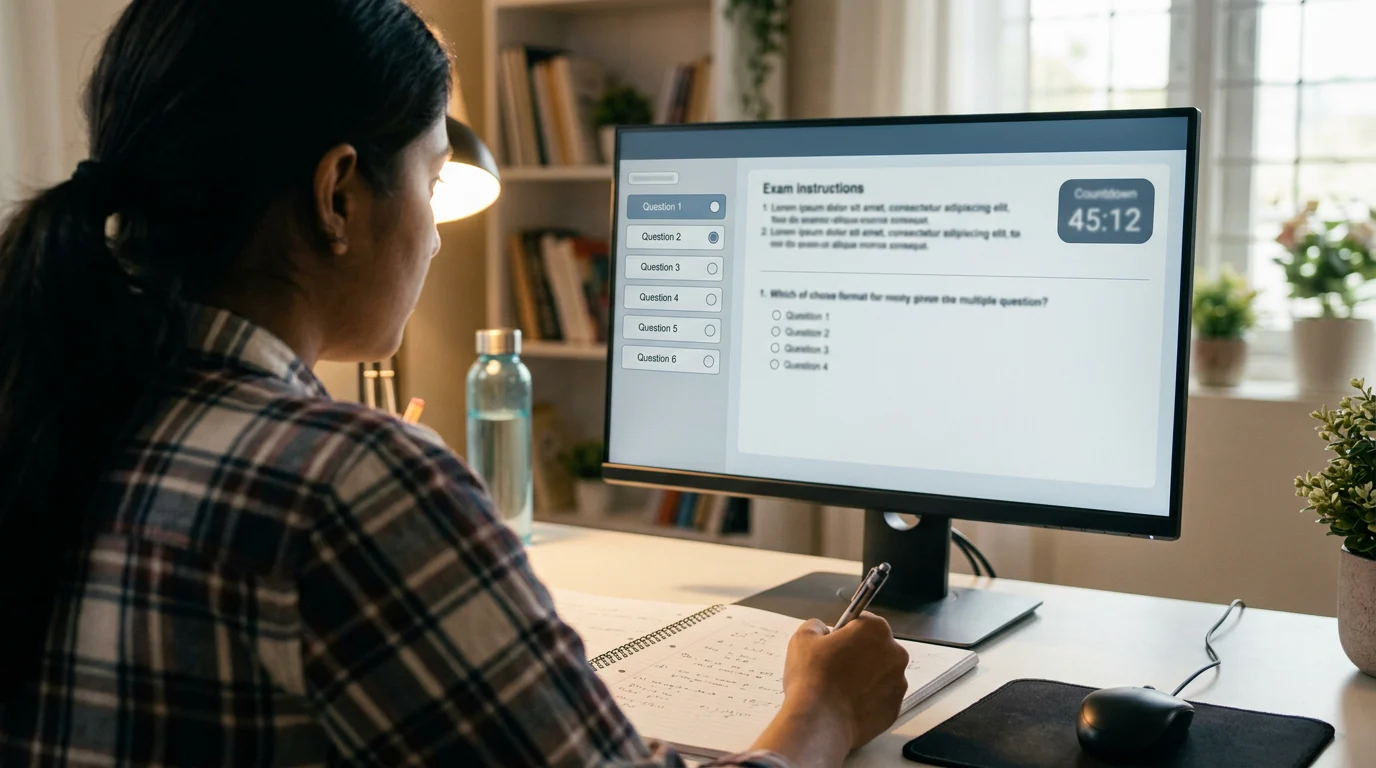
- Open the official CET Cell website and find the current MHT-CET notices or examination portal.
- Select a mock link only when it clearly matches the current year and your PCM or PCB group.
- Register or log in only if the live page asks you to do so. Do not assume that an application login or a previous-year account will work.
- Read the instructions, verify the displayed profile details, and check the chosen language before starting.
- Begin the first 90-minute group, Physics and Chemistry for both PCM and PCB.
- Use the question palette to revisit questions, save a selected response before leaving it, and mark uncertain questions for review.
- Watch the timer. The first group is auto-submitted after 90 minutes, then Mathematics or Biology opens for the remaining 90 minutes.
The official pattern confirms that the first group locks before the next group becomes available. Build your attempt order around that boundary, rather than imagining you can recover Physics time during Mathematics. Our Physics accuracy plan helps connect better pacing to a repeatable next practice session.
What Does the Current CBT Mock Reproduce, and What Can It Not Prove?
The official CBT rules confirm one-question-at-a-time presentation, four-option MCQs, the timer, and the two-part session flow. A current official practice attempt can familiarise you with those controls, especially if you have not recently solved a full paper on a desktop-style CBT screen.
| What It Can Validate | What It Cannot Prove |
|---|---|
| Your comfort with the released mock interface | Your final percentile |
| Your ability to pace two 90-minute groups | Future paper difficulty across shifts |
| Whether you save, review, and revisit effectively | Exact exam-centre hardware or conditions |
| Which chapters cost time in one attempt | Whether one revision session permanently fixed a weakness |
The official brochure also distinguishes percentile from percentage marks, so a raw mock score cannot stand in for an admission prediction. Use our practice-support guide when comparing what self-review can fix and where you need more structured support.
How Should Repeaters Turn a Result into a Correction Loop?
The useful question after a mock is not “Was my score good?” It is “Which repeatable mistake cost the most marks or minutes?” We recommend recording the result before looking for reassurance, because vague memory turns every error into “I need to study more.”

Record the Questions That Changed Your Result
Use this worksheet immediately after the mock. Copy it into a spreadsheet or notebook, then sort it by chapter and error type.
| Question | Chapter | Time Spent | Outcome | Error Type | Correction Date |
|---|---|---|---|---|---|
| Correct, incorrect, unanswered, guessed | Concept, method, time, decision |
Add totals for attempted, correct, incorrect, unanswered, guessed correct, and guessed wrong. Our PCM error log gives the review a clear time limit, so analysis does not consume the revision session it should create.
Name the Actual Cause of Each Loss
- Concept Gap: You could not recall or apply the relevant Physics principle.
- Method Gap: You understood the idea but could not set up or complete the calculation.
- Time Loss: You spent too long on one question or reached an easy question too late.
- Decision Error: You misread, skipped unnecessarily, guessed without a basis, or failed to return to a marked question.
Run a Short Correction Cycle
Choose the two chapters with the highest combined mark loss and time loss. Repair the concept, solve representative questions, then take a timed chapter or sectional retest within a few days. Use a revision comparison to decide what should fill the gap, then compare accuracy and time against the first attempt before scheduling another full mock.
How Do You Choose Supplementary Mocks and Solve Access Problems?
The best MHT-CET mock test for a repeater is not automatically the one with the biggest promise. We recommend choosing a practice series that gives fresh papers, current-pattern coverage, worked explanations, and enough analytics to expose whether Physics errors are conceptual or time-based.
Check each option against the current syllabus, section structure, number of fresh tests, availability of sectionals, solution quality, and chapter-level timing data. A free attempt can be useful for testing the report style first, which is why our free Physics mock should be judged by the quality of its chapter report, not merely by the score it produces.
If the official link is not yet active, return to the current official notices and brochure. If it is active but will not load, first check your device, internet connection, browser compatibility, and whether another active session is open. If a live service permits resuming after a disconnect, re-enter and confirm the recorded responses before treating the result as usable. For revision between full papers, use our score-improvement plan to keep practice tied to the chapters that still need work.
Practise the Physics Decisions with RG Lectures
At RG Lectures, we help MHT-CET Physics repeaters move from a disappointing mock result to a clear next study session. Our approach is simple: we ask what happened on the question, whether the loss came from a Physics concept, calculation, timing decision or avoidable reading error, then build practice around that evidence. We do not treat a single score as a verdict on a student’s ability. Instead, we help you use chapter-level review, focused Physics revision and timed retesting to see whether a correction truly holds under pressure. If your mock shows that Physics, rather than the entire paper, is costing you marks, our resources keep the next step specific. We want every practice session to leave you with a prioritised, workable action list for the week ahead. Start by exploring our lessons, revision support and preparation tools at RG Lectures Home.
FAQs on Official MHT-CET Mock Test
Is the Official MHT-CET Mock Link Active Every Year?
No. Mock links may be seasonal or limited. Check the current MHT-CET notice and brochure before relying on saved pages, archived routes, or previous-year instructions online.
Does a Mock Score Predict My MHT-CET Percentile?
No. Percentile is not percentage marks, and one practice score cannot reproduce the shift-wise comparison used when official MHT-CET results are calculated for candidates each year.
Do Repeaters Need More Than One MHT-CET Mock?
Yes. Use the released mock to learn the interface, then take fresh full mocks and sectionals to test whether revision improves accuracy, pace, confidence, and decisions under pressure.
What Should I Do If No Mock Link Appears?
If no current link appears, revisit official notices and the brochure. Do not assume an old page has the current syllabus, timing, interface, or access rules.
What Should I Record After Every Mock?
Record attempted, correct, incorrect, unanswered, and guessed questions. Add chapter, time spent, error type, and correction date to turn each score into a revision decision.