Recorded Physics Lectures vs Live Doubt Solving for JEE Retention?
Recorded Physics lectures vs live doubt solving for JEE: compare retention, feedback, transfer and a five-step hybrid study cycle.
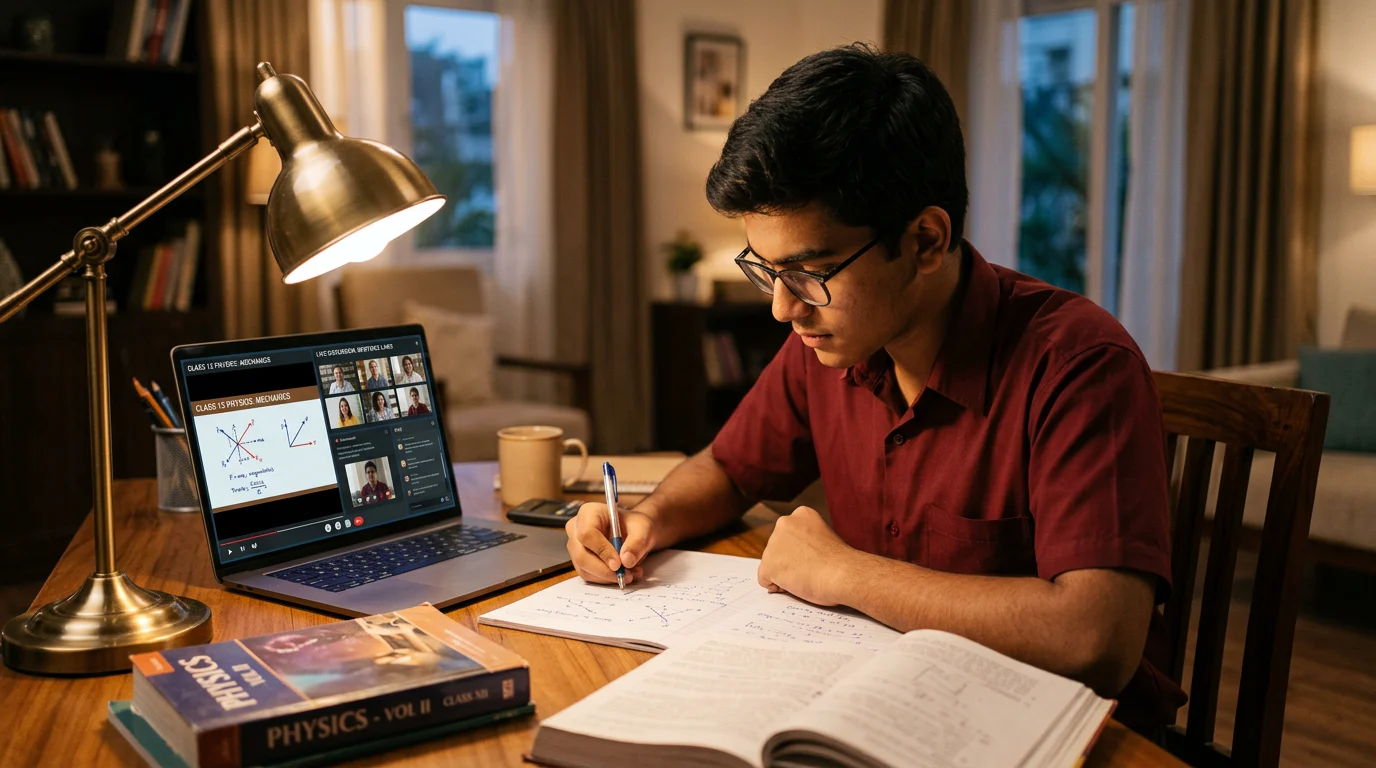
Recorded Physics Lectures vs Live Doubt Solving for JEE Retention?
Online delivery alone does not decide what stays in memory. A 2024 meta-analysis covering 1,902 learners found only a trivial average knowledge difference between synchronous and asynchronous formats.
With recorded Physics lectures vs live doubt solving, our verdict is simple: recordings are better for controlled explanation and repeat viewing, while live doubts are better for exposing misconceptions and forcing active retrieval. Neither guarantees retention. We recommend using recordings for first learning, independent problems for retrieval, live support for unresolved reasoning gaps, then delayed mixed practice to test transfer.
We will compare both formats through recall, setup quality, recurring errors and unfamiliar JEE-style problems, then show how to combine them without wasting study time.
How Do Recorded Physics Lectures vs Live Doubt Solving Compare?
A recording gives you control over the teaching pace. You can pause before a sign convention, replay a derivation, and revisit one timestamp without asking an entire group to wait. A live doubt session gives us something a replay cannot: your attempted reasoning in real time. That lets a mentor identify whether the problem is the concept, the diagram, the equation choice, or an assumption you never noticed.
| Criterion | Recorded Physics Lectures | Live Doubt Solving | Retention Implication |
|---|---|---|---|
| Control And Pacing | High, with pause and replay | Limited by the session pace | Use recordings for first-pass explanations |
| Interaction | Usually delayed | Immediate | Use live time to test reasoning aloud |
| Feedback | Self-checked or delayed | Can be specific and immediate | Ask why a step fails, not only for an answer |
| Retrieval Pressure | Must be created by the student | Can be prompted in the session | Watching alone is not retrieval |
| Replay Value | High | Lower unless notes are kept | Revisit only the failed step |
| Scheduling | Flexible | Fixed | Match the format to your available study window |
| Best Hybrid Role | Explanation and targeted repair | Misconception diagnosis and feedback | Combine both with delayed retesting |
We do not treat a live seat as proof of engagement or a completed video as proof of learning. For students who need real-time support after an attempt, our guide to live doubt support can help frame the kind of help to look for.
Why Can a Clear Lecture Still Disappear in a JEE Problem?
Following a teacher’s derivation can create immediate understanding because every cue is visible: the diagram, the chosen law, and the next algebraic step. JEE Physics asks for more. Delayed recall means you can rebuild the principle later without notes. Transfer means you can choose that principle when the surface details change, such as moving from a familiar pulley setup to an inclined-plane constraint problem.
Immediate Understanding Is Not Delayed Recall
After a lecture on circular motion, ask yourself to close the notebook and state what supplies centripetal acceleration in the exact situation discussed. If you need to see the diagram before the idea returns, you have familiarity, not yet dependable recall.
Delayed Recall Is Not Transfer
A student may reproduce a solved capacitance question and still freeze when the connection changes. Transfer requires identifying which quantity is conserved, drawing a fresh circuit, and explaining the choice before calculation. That is why our practice should include changed-context problems rather than only duplicates.
Passive Rewatching Can Create False Confidence
A 2019 classroom study with 102 students found rewatching supported stronger immediate performance, but had no one-week retention advantage over retrieval practice and required more time for the same long-term gain. We therefore use replay as a repair tool, not a default revision method.
Convert viewing into active work: pause before the teacher reveals the next step, write the governing law and setup unaided, then compare. If blanking keeps appearing even after revision, use a mock blanking diagnosis to separate a retrieval gap from an anxiety pattern.
What Should You Measure Before Choosing a Format?
We recommend tracking evidence that survives after the lecture is gone. A completed playlist, a long attendance streak, or the feeling that a solution looked obvious cannot show whether you can start a new problem independently. Four simple checks reveal more, and none requires us to promise a score increase.
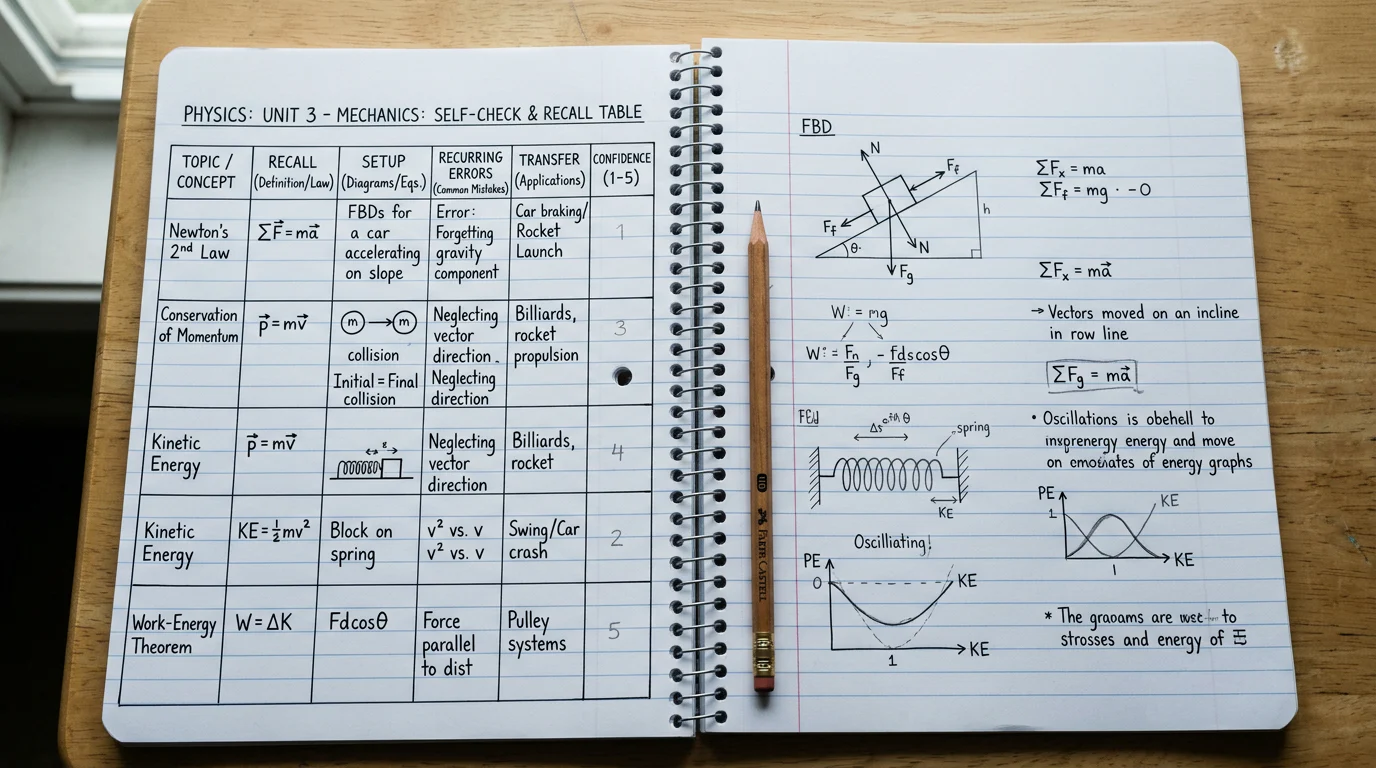
| Retention Measure | Closed-Book Check | What To Record | What A Weak Result Suggests |
|---|---|---|---|
| Delayed Recall | Rebuild the principle after a delay | Correct principle and setup | The explanation felt familiar but was not retrievable |
| Unaided Setup | Start a fresh numerical without notes | Diagram, variables and law chosen | The first decision is unstable |
| Error Recurrence | Redo a similar question after feedback | Same error, yes or no | Feedback was heard but not applied |
| Transfer | Solve a changed-context question | Principle choice and justification | Learning is tied to one template |
Feedback matters most when it explains the missing reasoning. A feedback meta-analysis comparing 77 experiments and 163 effect sizes found elaborated feedback most likely to rank best for recall and transfer, ahead of simply marking an answer right or wrong.
For a useful weekly record, write the chapter, error type, failed step, correction, and delayed retest result. When you need to resolve a clearly documented blockage, use instant JEE doubt help after you have attempted the question first.
How Can You Combine Recordings and Live Doubts Without Wasting Either?
The most effective setup gives each format one job. We use recordings to explain, solo attempts to reveal the gap, and live doubts to correct the gap before it hardens into a repeated mistake. Rewatching the whole lesson because one step failed often avoids the actual task: recalling and applying the idea yourself.
Step 1: Learn One Recording Segment
Watch a manageable concept or derivation segment. Mark only the moment where a decision becomes unclear, such as choosing the force direction or defining the constraint. Do not make a long list of vague doubts.
Step 2: Recall and Set up Closed-Book
Close the video and write the diagram, known quantities, governing law, assumptions and first equation. This exposes whether the setup exists in memory before the solution is visible.
Step 3: Attempt Direct and Changed Problems
Solve one direct problem, then one altered-context problem. Record the exact line where you stopped. If the mistake is still unclear after an honest attempt, bring that work to one-to-one versus group help.
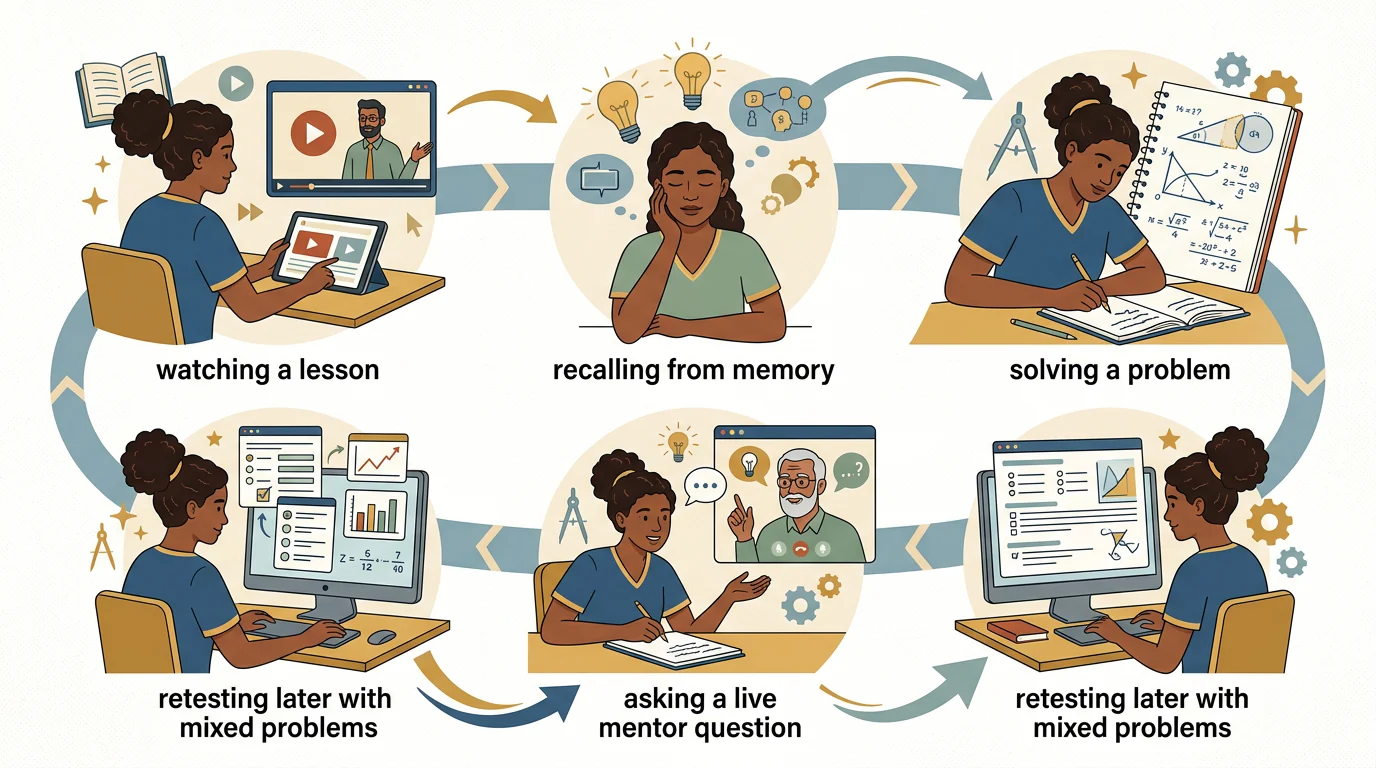
Step 4: Resolve the Reasoning Gap Live
Explain what you tried before asking for a solution. Ask which principle applies, why your setup failed, or what assumption was invalid. After feedback, redo the same problem without looking at the corrected work.
Step 5: Retest Later with Mixed Practice
Return after a delay and solve a mixed problem without notes. A spacing experiment found that longer total spacing across repeated retrieval produced a 200% long-term retention improvement over no spacing. We treat next-day and later-week retests as a practical starting routine, then adjust to your schedule.
Good doubt support should improve the next independent attempt, not create dependence on the next explanation. Our standard for Physics mentoring quality is built around that distinction.
What Does a Productive Live JEE Physics Doubt Look Like?
A useful live doubt is not “I do not understand electrostatics.” It is evidence of thinking: the problem, the attempted route, the exact blockage and a question precise enough to diagnose the misconception. This preparation lets us spend live time on the decision that changes future problems.
Use this template before joining a session:
- Topic And Problem: State the chapter and copy the relevant question details.
- My Diagram And Known Values: Show the representation you built before calculating.
- What I Tried: List the governing law and equation route you selected.
- Exact Blockage: Identify the line where your reasoning stopped or conflicted.
- Specific Question: Ask what remains conserved, why a direction changes, or why one law applies over another.
For a conceptual example, a student working on friction should show the free-body diagram, state the predicted friction direction, and ask why that direction changes under the stated acceleration. For a multi-step example, a student solving a capacitor network should show the equivalent-capacitance route, identify where charge conservation was misapplied, and ask which physical quantity remains conserved.
Students balancing school and a fixed timetable can use JEE schedule guidance to reserve a repeatable doubt window instead of waiting until confusion has accumulated.
Which Setup Fits Your JEE Physics Study Pattern?
We recommend choosing a starting point based on the problem you can observe, then keeping the retention checks constant. A disciplined student can use recordings efficiently, but still needs closed-book retrieval. A student who repeatedly selects the wrong law may need live diagnostic support sooner, but still needs delayed retesting afterward.
| Study Pattern | Start With | Non-Negotiable Safeguard |
|---|---|---|
| Disciplined Self-Learner | Recorded explanations and planned doubt slots | Closed-book recall and delayed mixed practice |
| Recurring Misconceptions | Prepared live doubts after a first pass | Bring attempted steps and an error record |
| Tight School Or Travel Schedule | Recordings as the core | Fixed weekly retrieval and doubt windows |
| Familiar Examples, Weak New Problems | Hybrid cycle | Prioritise changed-context questions |
| Frequent Missed Live Sessions | Recordings first | Submit prepared doubts at the next available session |
The format choice should become clearer after two or three chapter cycles. If delayed recall, unaided setup and transfer improve, keep the system. If the same error returns, change the feedback or practice step before buying more content.
Learn with RG Lectures
At RG Lectures, we built our Physics support around the moment a student can name the step that broke, not around making them rewatch an entire chapter. Our recorded explanations let you control pace when a derivation needs a second pass. Our doubt-focused support then gives you a place to test a setup, explain an attempted route and correct a misconception before it becomes a repeated error. Use the five-step cycle in this article to decide whether you need replay, a prepared doubt, or another mixed problem. If your issue is recurring errors rather than a single missed explanation, bring your written attempt and error log. We can help you turn that evidence into the next study action, while you keep ownership of the practice and retest. Explore our Physics learning resources at RG Lectures and choose a routine you can sustain week after week.
FAQs on Recorded Physics Lectures vs Live Doubt Solving
These answers address the format choice, but each still points back to the same test: can you recall, set up and transfer the Physics idea after help is removed?
Are Recorded Physics Lectures or Live Classes Better for JEE Retention?
Recordings support controllable explanation, while live sessions provide diagnostic feedback. Retention improves when either format includes closed-book retrieval, attempted problems, corrective feedback and delayed retests.
How Do I Turn a Recorded Physics Lecture into Retrieval Practice?
Pause before the next solution step, write the principle, diagram and setup without notes, attempt a related problem, then reopen the recording only to check failure.
What Should I Prepare Before a Live JEE Physics Doubt Session?
Bring the problem, your diagram, attempted steps, the exact point where reasoning stopped, your prediction and one specific question about the applicable principle or setup.
How Can I Test Whether a Physics Concept Transfers?
After a delay, solve a changed-context problem closed-book. Record whether you chose the governing principle, built the setup independently and avoided the previous error.
Does This Comparison Also Apply to NEET Physics Preparation?
Yes, the recall, feedback and delayed-retest process still applies. Use practice questions aligned with the current official exam syllabus and your recurring error patterns.