

TL;DR
We show students how to separate timed pressure, retrieval failure, incomplete mastery, calculation weakness, and poor question selection when JEE mock scores fall. Our process uses matched timed and untimed questions, a six-category error log, a calibrated score trend, and a 48-hour repair loop, with clear guidance for seeking mental-health support.
JEE Mock Blanking: Anxiety or a Preparation Gap?
A JEE Main Paper 1 mock asks students to handle 75 questions in 180 minutes, with +4 for a correct answer and −1 for an incorrect one, so time pressure and selection decisions can change a score quickly. See the current NTA bulletin for the official format.
JEE mock-test blanking is not automatically test anxiety. When you can solve matched questions untimed without notes but freeze or lose time under a clock, pressure, retrieval, or selection is the likelier issue. When the method is still unavailable untimed, preparation is incomplete. Falling scores call for an error-pattern diagnosis, not automatically more study hours.
We will show you how to identify the pattern before, during, and after a mock, then choose one repair action that fits the evidence.
How Can You Diagnose JEE Mock-Test Blanking Before Your Next Mock?
We start by treating a blanking episode as evidence to inspect, not a verdict on ability. A student who studies for eight hours can still be rereading familiar material, practising only comfortable problems, or taking mocks under inconsistent conditions. None of those habits proves that concepts are secure when retrieval and timing matter.
Test anxiety can affect performance, but it should not become the default explanation for every difficult paper. A 2023 review synthesised 76 studies across 53,617 children and found test anxiety was associated with poorer academic outcomes. For JEE students, that means anxiety is worth noticing, while the pattern in your own work still decides the next action.
| What You Observe | Likely First Hypothesis | Evidence To Check | First Correction |
|---|---|---|---|
| You remember the method after time ends | Pressure or retrieval failure | Timed and untimed matched questions | Timed recovery drills |
| You cannot state the first step untimed | Concept gap | Solve again without notes | Relearn the principle |
| Your setup is right but the answer is wrong | Arithmetic weakness | Review units, signs, and calculations | Short accuracy drills |
| You spend too long on a few questions | Time or selection problem | Per-question time log | Two-pass question scan |
| Scores fall only on unfamiliar mocks | Difficulty or condition distortion | Source, coverage, and conditions | Compare calibrated papers only |
Our blanking diagnosis goes deeper into these patterns, but the key distinction is simple: later recall points to access under pressure, while no recall without help points to learning that is not complete yet.
How Do Timed and Untimed Tests Reveal the Real Gap?
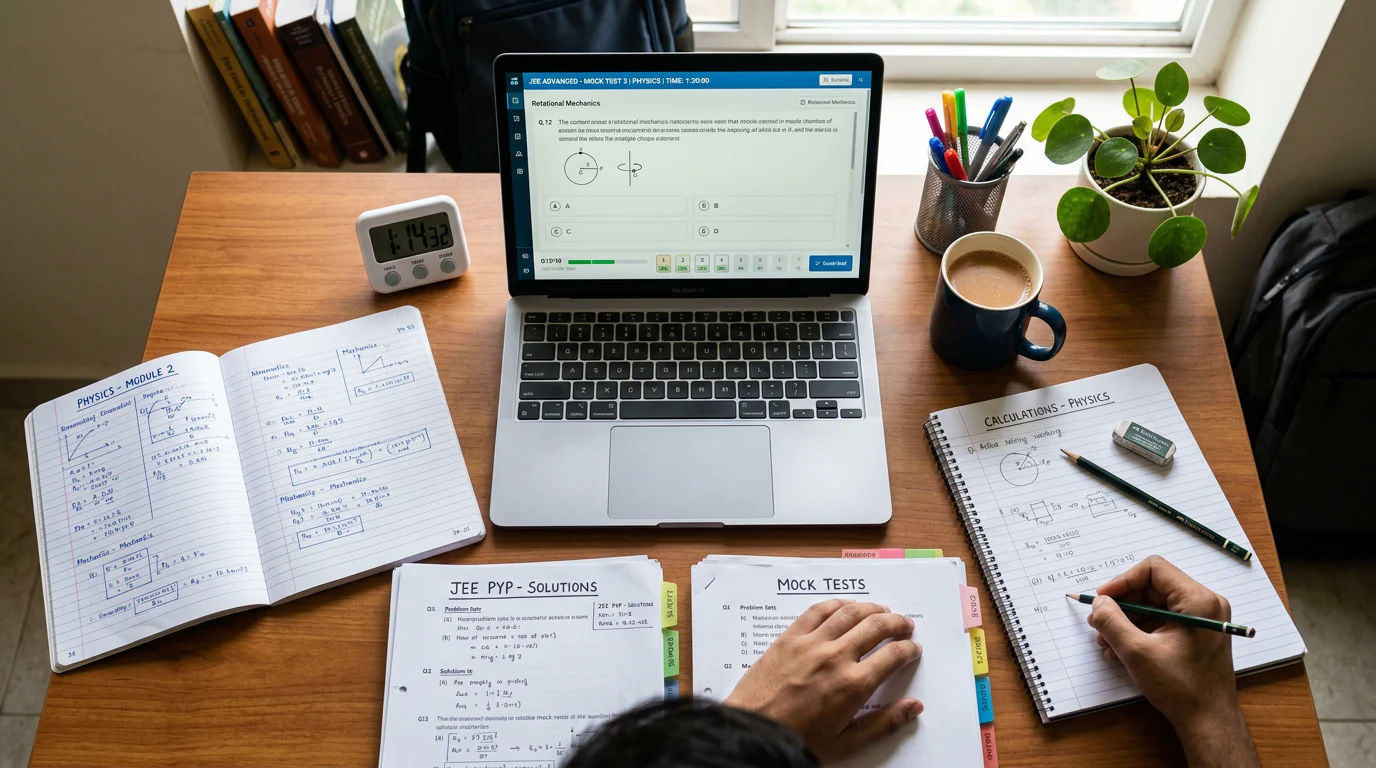
A matched two-pass test is more useful than taking another full mock immediately. Use six to ten fresh questions from one chapter, with similar question type and difficulty. Do not reuse questions you have already seen, because recognition can make a weak topic feel stronger than it is.
Run the Timed Pass First
Set a realistic time budget and record the answer, time spent, confidence, and any moment when your mind went blank. Work without notes, solutions, or pauses. The aim is not to prove toughness. It is to capture what breaks when time pressure appears.
Repeat with Fresh Untimed Questions
After a short break, attempt matched fresh questions without notes. If you can explain the method and complete the solution untimed, the topic may need better retrieval, pacing, or pressure practice. If you still cannot identify the governing principle, classify it as a concept gap.
Read the Result Without Overreacting
A timed error followed by an untimed correct solution is not proof of anxiety, but it is a reason to practise under manageable time pressure. An error in both conditions is not a reason to panic, either. It gives you a clear relearning target.
We use this comparison because active recall gives better information than another round of rereading. The IES guidance identifies quizzing with active retrieval as a strongly supported learning practice. Use a mock attempt framework to set your first-pass time limits before starting.
What Should You Do Before and During a Mock?
Before a mock, make the conditions repeatable. Use the same start time where possible, a computer interface, rough-work paper, a clear timer, and an interruption rule. If every mock happens in a different place, after different sleep, with different syllabus coverage, the score trend will be noisy before it becomes useful.
The official CBT instructions say candidates can revisit and modify answers, and NTA provides sample tests for familiarisation. Use the CBT practice guidance to practise the interface itself, especially if your usual preparation is paper-based.
When you blank, do not keep rereading the question until panic rises. Use a short reset, then make a decision.
- Name The Event: Tell yourself, “I am blanking on this question,” rather than “I do not know anything.”
- Write The Givens: Put down known values, units, diagrams, or the chapter cue. This may restart retrieval without forcing a full solution.
- Set A Stop-Loss: If no first principle appears within your planned first-pass time, mark the question and move on.
- Return With Intention: Reopen it only when you can name the method, not merely because it feels unfinished.
Question selection is part of preparation, not a shortcut around preparation. A student who solves easy questions accurately but sacrifices them for one difficult question has a strategy issue, not necessarily weak Physics, Chemistry, or Mathematics. Our comparison of mock formats can help you make practice conditions closer to the format you expect to face.
How Do You Log Mistakes and Read a Falling Score Trend?
The most useful mock review begins after the score appears. We recommend logging every wrong, skipped, and unusually slow question. The log should show whether the score loss came from missing knowledge, a poor calculation, a misread condition, bad pacing, a low-value attempt, or a pressure response.
| Log Field | What To Record | What It Reveals |
|---|---|---|
| Attempted, correct, wrong, skipped | Count each outcome | Accuracy versus selection |
| Time spent | Time on every slow or missed question | Pacing leaks |
| Confidence | Low, medium, or high before answering | Guessing and overconfidence |
| Post-Test Solvability | Whether you solve it later without notes | Retrieval versus mastery |
| Error Category | Conceptual, arithmetic, interpretation, time, strategy, or panic | Repair action |
| Next Action | One task due within 48 hours | Whether review changes practice |
Use Six Clear Error Categories
A conceptual error means the principle, model, or formula selection was wrong. Arithmetic means the method was sound but execution failed. Interpretation means you missed wording, a graph detail, a unit, or a condition. Time management means a solvable question was lost to pacing. Strategy means you chose, guessed, or returned poorly. Panic-related loss means distress interrupted attention even though later recall was available.
Calibrate Before Calling It a Decline
Raw mock scores are not automatically comparable. JEE Main itself uses a normalisation process across shifts, so score movement on unrelated mock sources is not a direct prediction of percentile. The NTA explanation is a useful reminder to compare like with like.
| Mock | Test Source | Difficulty Calibration | Testing Conditions | Score Record | Best Comparison |
|---|---|---|---|---|---|
| First | Official past paper | Official level | Full 180-minute CBT simulation | Raw score, attempts, accuracy | Later official papers |
| Second | Same source type | Similar syllabus coverage | Same device and interruption rule | Raw score, attempts, accuracy | First mock |
| Third | New source | Unfamiliar until reviewed | Different interface or conditions | Raw score, attempts, accuracy | Error pattern, not mastery trend |
A pattern across matched mocks matters more than one harsh paper. Use our score diagnostic when the same category repeats, rather than responding to every drop by adding another full-length test.
What Does a 48-Hour Repair Loop Look Like?
A good review ends with a scheduled correction, not a long list of chapters to “revise.” We use a 48-hour loop because it turns a mock result into fresh retrieval before the missed method becomes another forgotten solution.
Before starting the loop, choose no more than two recurring errors from the mock. A focused repair is easier to test than a broad promise to revise everything. Keep the original question, your working, and the corrected method together so you can see exactly what changes during the retest.
Step One: Classify Within Thirty Minutes
Mark each loss with one category, then choose the smallest useful repair. A conceptual error needs relearning. A calculation error needs controlled calculation practice. A panic-related loss needs a lower-stakes timed simulation and a practised reset.
Step Two: Relearn or Drill Within Twelve Hours
For a concept gap, review one worked example, explain the principle aloud, and solve one close problem without looking. For arithmetic, complete a short set that requires unit, sign, and magnitude checks. For interpretation, annotate the givens and the target quantity before beginning each solution. If a specific Physics doubt keeps blocking the repair, use instant Physics support instead of collecting more unresolved questions.
Step Three: Re-Test Within Forty-Eight Hours
Use fresh questions, first untimed and then timed. Record whether the method appears faster, whether accuracy survives the clock, and whether your confidence is becoming more realistic. For organised revision material that supports these repairs, explore our study resources.
When to Escalate Beyond Study Strategy
Persistent severe distress, panic symptoms, disrupted sleep or eating, distress outside test situations, or any thoughts of self-harm need support beyond a mock routine. Speak with a parent, guardian, school counsellor, doctor, or licensed mental-health professional. In India, the government’s 24-hour Tele-MANAS service is available at 14416 and 1800-89-14416.
Build a Better Mock Review with RG Lectures
At RG Lectures, we help online-test-preparation students turn a disappointing mock into a next-step decision. Our approach keeps the work specific: identify whether the loss came from mastery, retrieval, calculation, interpretation, pacing, or panic, then practise the smallest correction that can change the next result. We do not treat more hours or more full mocks as automatic answers. We encourage students to bring a completed error log, a timed and untimed comparison, and two or three questions they could not solve without help. That gives our teaching team something useful to discuss and gives students a way to measure progress beyond one score. Our materials fit a demanding online preparation routine with clear feedback. If you want structured Physics practice, revision support, and help reviewing the mistakes that keep repeating, explore our study resources today and begin with RG Lectures Home.
FAQs on JEE Mock-test Blanking
Why Do I Blank During JEE Mock Tests When I Know the Chapter?
Try matched timed and untimed questions without notes. If the method returns when time pressure lifts, practise retrieval and pacing before you relearn that chapter.
How Do I Tell Anxiety from a Concept Gap?
Record time, confidence, later solvability, and error category. A weakness repeated across comparable mocks is more useful evidence than one difficult paper or changed conditions.
Why Are My Scores Falling Despite Eight Study Hours?
Eight study hours may include rereading, unfinished problem solving, or mixed-quality materials. Use fresh retrieval checks and error patterns to decide what needs repair next.
How Many Mocks Should I Take When Scores Fall?
Take a mock when you can review it fully and act on results. Focused timed sets and repair loops can be more useful during early improvement.