7 companies compared
Engineering Mechanics Books: Which Units Need More Than a Book
Engineering mechanics books suit formula units, but friction, free body diagrams and truss methods need worked solutions.

By Rahul Jeewani, Founder · Updated 13 Nov 2026
On this page
- 01The shortlist
- 02How we ranked them
- 03The companies in detail
- 04How to choose
- 05Which engineering mechanics units can you learn from a book alone?
- 06What does the SPPU Engineering Mechanics syllabus actually ask you to do?
- 07Why do students get friction wrong even after finishing the course?
- 08Which engineering mechanics book should you buy for first year?
- 09How do you cover the units a book can't teach?
- 10Key takeaways
- 11Method and sources
- 12Frequently asked
The short answer
A book is enough for centroids, moment of inertia and uniform-acceleration kinematics. Friction, free body diagrams, truss method choice and choosing the right principle in kinetics need worked solutions. For SPPU first-year students, pair a library text book with RG Lectures worked video solutions.
The shortlist
- 1Engineering Mechanics, Pune University (RG Lectures)Our companyFor first-year SPPU students
- 2Singer, Engineering MechanicsFor the SPPU-named text book
- 3Hibbeler, Engineering Mechanics (Statics and Dynamics)For the second SPPU text book
- 4Engineering Mechanics (All Universities) (RG Lectures)For students outside Pune University
- 5Khurmi, A Textbook of Engineering MechanicsFor extra practice numericals
- 6Bhavikatti, Engineering MechanicsFor two-dimensional force systems
- 7Engineering Mechanics: Statics (open textbook)For a free statics reference
How we ranked them
- Named on the SPPU first-year text book list, or a title students ask for by name
- Covers units of the first-year Engineering Mechanics syllabus
- Has a stated price, page count or licence
- Available to a first-year student as a book or recorded course
The companies in detail
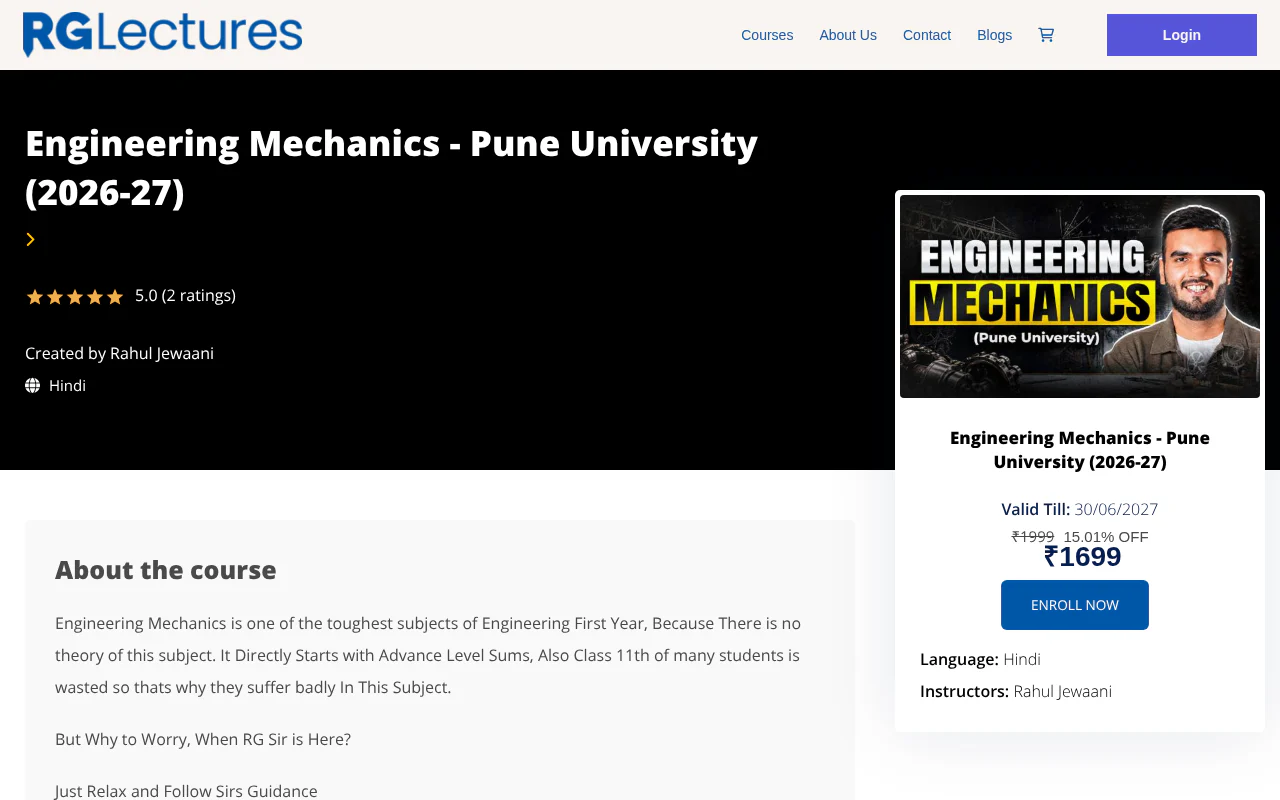
Engineering Mechanics, Pune University (RG Lectures)
Recorded Hindi video lectures with practice sets
- Format
- Recorded Hindi lectures
- SPPU fit
- Full first-year syllabus
- Scope
- Complete SPPU first-year syllabus with practice sets
- Best use
- Friction, free body diagrams, truss method choice
The best pick for first-year SPPU students. It is taught by Rahul Jewaani, starts from the basics, and also applies to Pune University autonomous colleges.
Strengths
- Covers the complete SPPU first-year syllabus
- Recorded Hindi video lectures with practice sets
- Valid until 30 June 2027
Singer, Engineering Mechanics
SPPU text book, 3rd edition, Harper and Row
- Format
- Printed book
- SPPU fit
- SPPU text book
- Scope
- 3rd edition, Harper and Row
- Best use
- Extra sums from a library copy
One of the two text books the SPPU syllabus names. Check your college library for a copy before paying.
Strengths
- Named as a text book in the SPPU syllabus
- Ferdinand Singer's 3rd edition
- Published by Harper and Row
Limitations
- A book alone leaves friction, free body diagrams and truss method choice without worked decisions
Hibbeler, Engineering Mechanics (Statics and Dynamics)
SPPU text book from Pearson Education
- Format
- Printed book
- SPPU fit
- SPPU text book
- Scope
- Statics and dynamics, Pearson Education
- Best use
- Extra sums from a library copy
The other text book the SPPU syllabus names. Use a library copy for sums and pair it with worked solutions for the decision units.
Strengths
- Named as a text book in the SPPU syllabus
- Covers statics and dynamics
- Published by Pearson Education
Limitations
- A book alone leaves friction, free body diagrams and truss method choice without worked decisions
Engineering Mechanics (All Universities) (RG Lectures)
Hindi, self-paced course for several universities
- Format
- Hindi, self-paced course
- SPPU fit
- Built for several universities
- Scope
- Mumbai, Pune, Nagpur, Kolhapur, Amravati, DBATU
- Best use
- Students outside Pune University
Built for Mumbai, Pune, Nagpur, Kolhapur, Amravati and Dr. Babasaheb Ambedkar Technological University (DBATU) students and autonomous colleges.
Strengths
- Covers students of six university groups and autonomous colleges
- In Hindi and self-paced
- Priced at ₹1,699 as of November 2026
Limitations
- Access is valid only until 30 June 2027, after which it ends
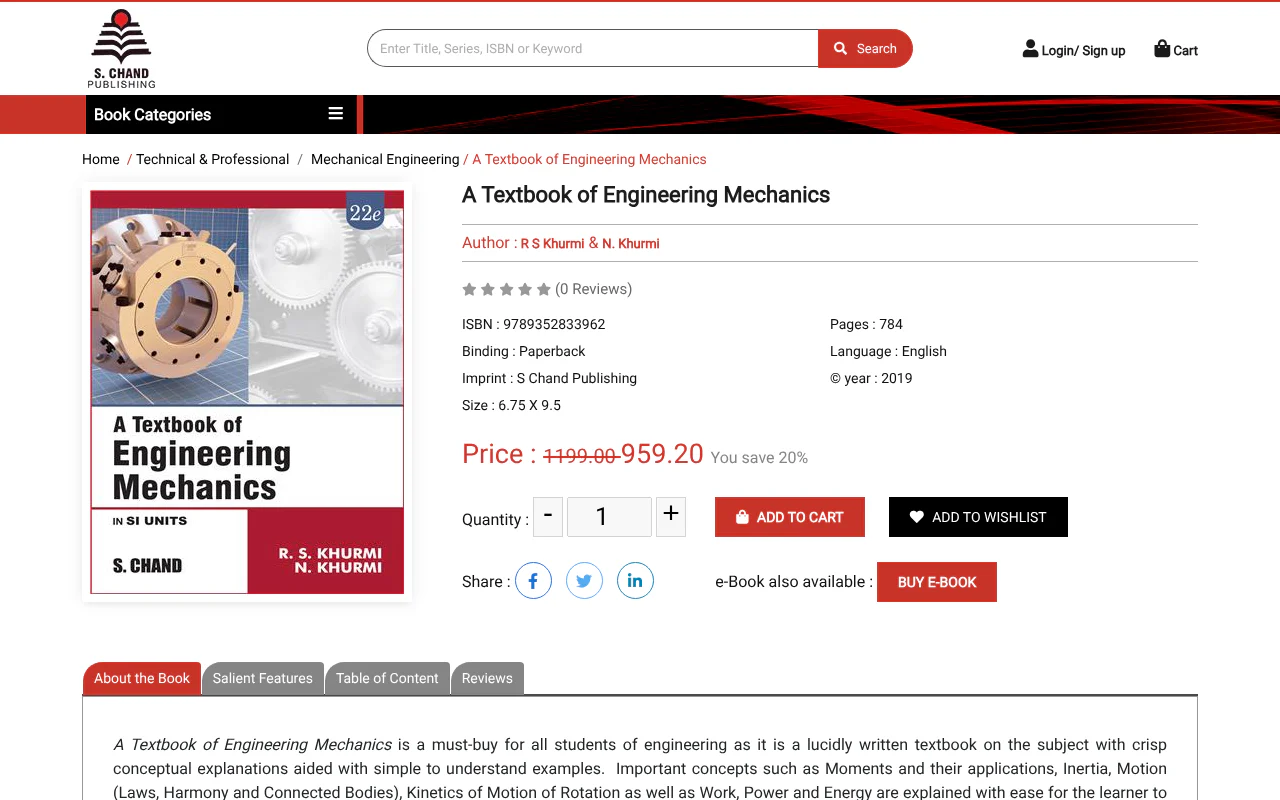
Khurmi, A Textbook of Engineering Mechanics
S Chand Publishing printed textbook
- Format
- Printed book
- SPPU fit
- Not on SPPU list
- Scope
- 784 pages, 2019 copyright
- Best use
- Practice volume
Its strength is practice volume. It is one of the two Indian titles students ask for by name.
Strengths
- Large practice volume
- 784 pages with a 2019 copyright year
- An earlier edition has a 4.07 rating from 177 Goodreads ratings
Limitations
- Not on the SPPU text book list, so it is not the book your syllabus names
- A book alone leaves friction, free body diagrams and truss method choice without worked decisions
Bhavikatti, Engineering Mechanics
Indian textbook students ask for by name
- Format
- Printed book
- SPPU fit
- Not on SPPU list
- Scope
- 510 pages, 2D only
- Best use
- Two-dimensional force systems
A reader review says its concepts are limited to 2 dimensions. SPPU's outcomes are also two-dimensional force systems, so the limit costs a first-year student nothing.
Strengths
- 4.00 rating from 377 Goodreads ratings
- 510 pages
- Two-dimensional scope matches SPPU's outcomes
Limitations
- Not on the SPPU text book list, so it is not the book your syllabus names
- A book alone leaves friction, free body diagrams and truss method choice without worked decisions
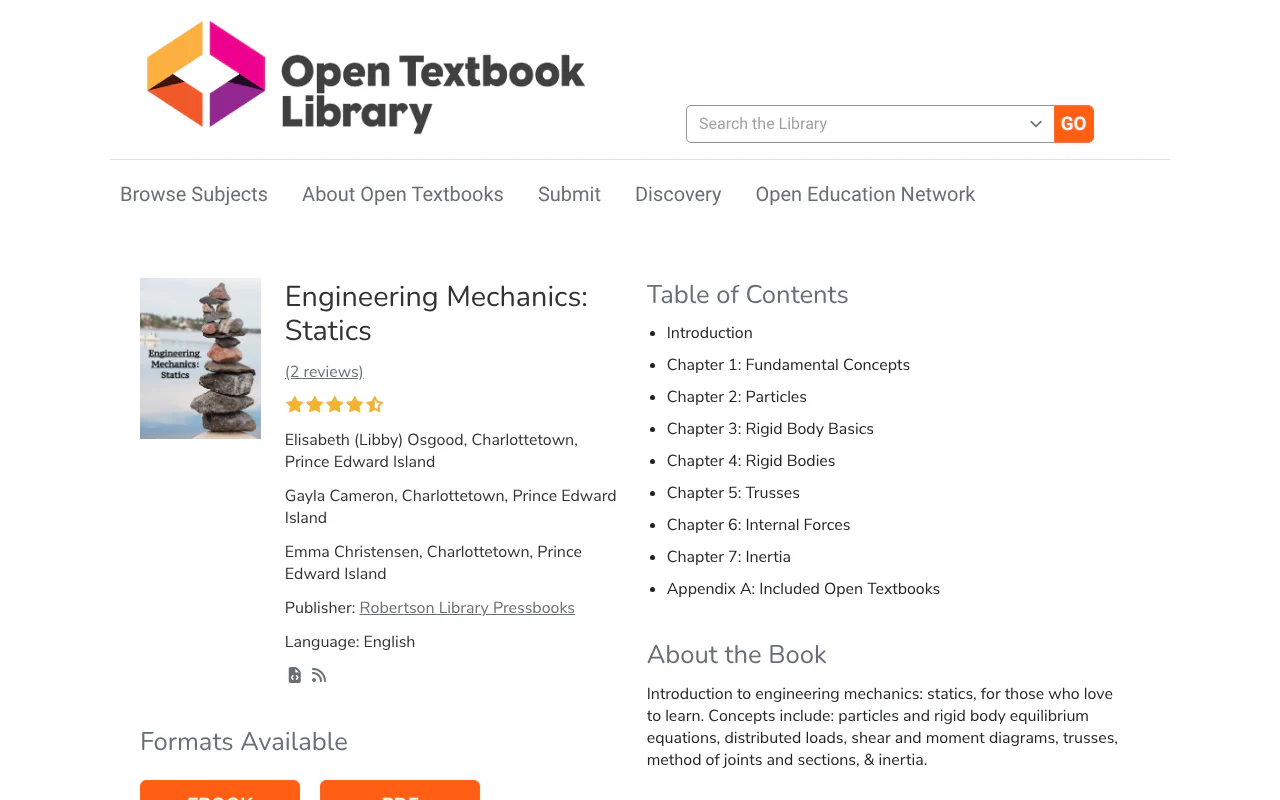
Engineering Mechanics: Statics (open textbook)
Free open textbook from Robertson Library Pressbooks
- Format
- Open textbook
- SPPU fit
- Statics only
- Scope
- 7 chapters, CC BY-NC-SA
- Best use
- Free statics reference
One reviewer on the Open Textbook Library noted its practice problems were limited. It is a legal free option for reading.
Strengths
- Free under a CC BY-NC-SA licence
- 7 chapters covering equilibrium, distributed loads, trusses and inertia
- Legal free option
Limitations
- It has no friction chapter, so Unit III friction needs another source
- Statics only, so Units IV and V need another source
How to choose
- 1
Check your library first
Look for the SPPU text books, Singer and Hibbeler, in your college library before paying for any book. - 2
Match the book to your syllabus
Singer and Hibbeler are the SPPU text books; Khurmi and Bhavikatti are not on that list. If your university is not SPPU, hold your own unit list against the table. - 3
Sort units by book or worked solution
Use a book for centroids, moment of inertia and uniform-acceleration kinematics. Use worked solutions for free body diagrams, friction, truss method choice and choosing the principle in kinetics. - 4
Check what the book leaves out
The open textbook has no friction chapter and covers statics only, so Units IV and V need another source. - 5
Check the access date and price
The RG Lectures courses cost ₹1,699 as of November 2026 and are valid until 30 June 2027. - 6
Work the sums with the book closed
Use one book for the lookup units, solved by hand with the book closed, and one source of worked solutions for the decision units.
Which engineering mechanics units can you learn from a book alone?
Centroids, moment of inertia and uniform-acceleration kinematics can be learned from a book alone. Friction, support reactions, truss method choice and the choice of principle in kinetics need worked solutions, because the hard step is a decision a printed answer hides. The table sorts the five SPPU units. It is our recommendation, built from the syllabus topics and the error data below.
Unit II deserves your most care. Units III and V both depend on it, so a weak free body diagram habit costs marks there as well. Our unit-by-unit SPPU study plan orders the units that way and sets the weekly problem counts.
- Unit (SPPU, 6 hours each)
- I. Force systems and resultants
- A book is enough for
- Resolving forces, centroid of composite figures, moment of inertia with the parallel and perpendicular axis theorems
- Start with a worked solution for
- Couples, and replacing a force system with one resultant
- Unit (SPPU, 6 hours each)
- II. Equilibrium
- A book is enough for
- Types of load, support and beam
- Start with a worked solution for
- Free body diagrams and support reactions
- Unit (SPPU, 6 hours each)
- III. Friction and trusses
- A book is enough for
- Laws of Coulomb friction, angle of repose, angle of friction, cone of friction
- Start with a worked solution for
- Direction of friction, deciding whether F equals μN (coefficient of friction times normal force), ladder friction, and choosing the method of joints or the method of sections for a truss (a frame of straight pin-jointed bars)
- Unit (SPPU, 6 hours each)
- IV. Kinematics of a particle
- A book is enough for
- Uniform acceleration, gravitational acceleration, projectile formulas
- Start with a worked solution for
- Variable acceleration and normal-tangential components (acceleration split along and across the path)
- Unit (SPPU, 6 hours each)
- V. Kinetics of a particle
- A book is enough for
- Statements of Newton's second law, energy conservation and impulse-momentum (the principle that force acting over time changes momentum)
- Start with a worked solution for
- Choosing which principle to apply to a given problem, and impact
What does the SPPU Engineering Mechanics syllabus actually ask you to do?
The SPPU first-year syllabus (2024 pattern) asks you to apply and analyse, not to recite. It runs 2 theory hours and 2 practical hours a week for 2 theory credits and 1 practical credit, across five units of 6 hours each, 30 theory hours in total.
Four course outcomes (CO2 to CO5) use the verbs "apply" (CO2, CO5) or "analyse" (CO3, CO4), and only CO1 says "understand". In our reading, a book that explains a concept well covers one outcome in five.
The syllabus also fixes the book list. The text books are Ferdinand Singer's Engineering Mechanics (3rd edition, Harper and Row) and R. C. Hibbeler's Engineering Mechanics (Statics and Dynamics) from Pearson Education. The lab list includes a coefficient of friction experiment and a beam support reaction experiment, so friction and equilibrium are also tested on the bench.
Why do students get friction wrong even after finishing the course?
Students treat friction as always equal to μN, when it only reaches μN at the point of slipping. In a 2004 statics concept-inventory study by Paul Steif of Carnegie Mellon University, only 18%, 25% and 35% of students answered the three friction questions correctly. The paper reports that this misconception persisted in students who had passed a statics course. It is an older, multiple-choice study of US students, so treat it as a strong pointer, not a measurement of SPPU.
Here is the mistake at work, with our working. A 12 kg block sits on a 25° slope with μ = 0.5 (g = 9.81 m/s²):
- Weight W = 12 × 9.81 = 117.7 N.
- Friction needed to hold it: W sin 25° = 49.8 N.
- Normal force: W cos 25° = 106.7 N, so the most friction available is μN = 0.5 × 106.7 = 53.3 N.
- 49.8 N is less than 53.3 N, so the block stays put and friction is 49.8 N.
Writing F = μN gives 53.3 N, about 7% too high, with every other step correct. A printed solution shows the right answer. It rarely shows the comparison that decides which equation applies.
Direction is the other trap. Students keep asking the same question: "how do you determine the direction of the 2 friction forces?" for a ladder resting on a wall and a floor. The ladder's base tends to slide away from the wall, so floor friction points towards the wall. The top tends to slide down, so wall friction points up. With both surfaces rough, the equations cannot fix both magnitudes, so the problem usually states that slipping is about to start at both contacts (limiting friction). Our friction method for inclines and ladders works through both cases.
Free body diagram slips cost just as much. Take a 5 kg block on a 30° incline with μ = 0.3 (g = 9.8 m/s²). The correct acceleration is g(sin 30° − μ cos 30°) = 2.35 m/s². Using N = mg instead gives g(sin 30° − μ) = 1.96 m/s², which is 17% low. Our five-check free body diagram routine catches this before the algebra starts.
Unit I is not entirely safe either. Static equivalence is the idea behind couples and replacing a force system with a resultant, which is why that topic sits in the worked-solution column above.
Which engineering mechanics book should you buy for first year?
Buy one book that matches your syllabus, and check your college library for the SPPU text books (Singer and Hibbeler) before paying. Khurmi and Bhavikatti are the two Indian titles students ask for by name.
Khurmi's A Textbook of Engineering Mechanics (S Chand Publishing) has 784 pages, a 2019 copyright year, a maximum retail price (MRP) of ₹1,199 and a selling price of ₹959.20 on S Chand's own page as of November 2026. Its strength is practice volume. An earlier edition has a 4.07 rating from 177 Goodreads ratings. It is not on the SPPU list.
Bhavikatti's Engineering Mechanics has 510 pages and a 4.00 rating from 377 Goodreads ratings. A reader review says "The concepts explained are limited to 2-dimensions only." That is one review, but SPPU's outcomes are also two-dimensional force systems, so the limit costs a first-year student nothing. It is not on the SPPU list.
The open textbook Engineering Mechanics: Statics is free under a Creative Commons Attribution-NonCommercial-ShareAlike (CC BY-NC-SA) licence from Robertson Library Pressbooks, with 7 chapters covering equilibrium, distributed loads, trusses and inertia. It has no friction chapter, and one reviewer on the Open Textbook Library noted its practice problems were limited. It is statics only, so Units IV and V need another source.
Our recommendation: one book for the lookup units, solved by hand with the book closed, and one source of worked solutions for the decision units in the table.
How do you cover the units a book can't teach?
Work every friction, equilibrium and truss problem with the same four steps and have someone show you each decision as it happens. Our routine is to draw the free body diagram, resolve the forces on chosen axes, write the equations, then verify the answer. For friction we add one step first: compare the friction needed with the friction available before using F = μN.
RG Lectures teaches the right-hand column units this way, in Engineering Mechanics, Pune University and in Engineering Mechanics (All Universities). If you are weighing free lectures against a paid course, our comparison with NPTEL Engineering Mechanics lines the free lectures up against the five SPPU units.
Padhna Aasaan Hai when each unit gets the right tool.
Key takeaways
- A book is enough for centroids, moment of inertia and uniform-acceleration kinematics. Free body diagrams, friction, truss method choice and choosing the right principle in kinetics need worked solutions.
- Friction is where students go wrong even after finishing a statics course, so friction needs worked solutions, not only a book.
- Use your library copy of Singer or Hibbeler for sums, and RG Lectures' course for friction, free body diagrams and truss method choice.
- Our Engineering Mechanics (Pune University) course costs ₹1,699 as of November 2026 and covers the complete SPPU first-year syllabus as recorded Hindi video lectures with practice sets, valid until 30 June 2027, and also applies to Pune University autonomous colleges.
How we built this list
The universe is the SPPU first-year text books, the Indian titles students ask for by name, a free open textbook and RG Lectures' two Engineering Mechanics courses, as of November 2026. Entries had to meet the criteria above. RG Lectures' SPPU course is ranked first as the pick for first-year SPPU students, and the others follow it. RG Lectures is one of the companies listed.
This page is published by Rg lectures. If anything here is out of date, tell us and we will correct it.
Sources
- 1.Mirror of the SPPU First Year Engineering (2024 Pattern) syllabus, hosted by DPCOE Pune, file dated 16 June 2024
- 2.Mirror of the SPPU First Year Engineering (2024 Pattern) syllabus, hosted by JIT Nashik, file dated July 2024
- 3.Steif, P. S., "Initial Data from a Statics Concept Inventory", ASEE Annual Conference, 2004
- 4.S Chand Publishing, A Textbook of Engineering Mechanics (R. S. Khurmi and N. Khurmi), price page as of November 2026
- 5.Open Textbook Library, Engineering Mechanics: Statics
- 6.Goodreads, Textbook of Engineering Mechanics by R. S. Khurmi
- 7.Goodreads, Engineering Mechanics by S. S. Bhavikatti
- 8.Physics Forums, "How do friction forces act on a ladder leaning against a wall?"
- 9.RG Lectures, Engineering Mechanics, Pune University course page
- 10.RG Lectures, Engineering Mechanics (All Universities) course page