6 companies compared
Engineering Physics Books: Match Your FE Syllabus Before You Buy
For first-year (FE) engineering physics books, start with RG Lectures' Engineering Physics courses for MU and SPPU, then add Avadhanulu or Gaur and Gupta.

By Rahul Jeewani, Founder · Updated 16 Nov 2026
On this page
- 01The shortlist
- 02How we ranked them
- 03The companies in detail
- 04How to choose
- 05Key takeaways
- 06Which engineering physics books and lectures should an MU or SPPU first-year student use?
- 07Why isn't one "standard" engineering physics book enough for every university?
- 08How do you check whether a book covers your syllabus?
- 09How much of Avadhanulu's textbook does the MU Applied Physics syllabus need?
- 10Which chapters of Avadhanulu match SPPU's BSC-102-BES units?
- 11Method and sources
- 12Frequently asked
The short answer
Avadhanulu and Gaur and Gupta are both on the textbook lists for MU and SPPU, but other universities name different books, so match any book to your own syllabus before buying. A book is good for you when it covers your syllabus, and a senior's recommendation helps only if the senior studied your syllabus.
The shortlist
- 1RG Lectures Engineering Physics (MU and SPPU)Our companyFor MU and SPPU first-year students
- 2Avadhanulu, A Textbook of Engineering PhysicsFor MU and SPPU textbook lists
- 3Gaur and Gupta, Engineering PhysicsFor MU and SPPU as an alternative textbook
- 4Vasudeva, Modern Engineering PhysicsFor MU as a second textbook
- 5Kittel, Introduction to Solid State PhysicsFor SPPU semiconductor depth
- 6Griffiths, Introduction to ElectrodynamicsFor MU's Electrodynamics module
How we ranked them
- Named as a textbook or reference in at least one first-year Physics syllabus we read (MU, SPPU, VTU or Anna University)
- Aimed at first-year engineering students
- Published in India or sold in an Indian edition
- Chapter or module titles can be matched against a syllabus
- Lectures: built around the MU or SPPU first-year syllabus
The companies in detail
RG Lectures Engineering Physics (MU and SPPU)
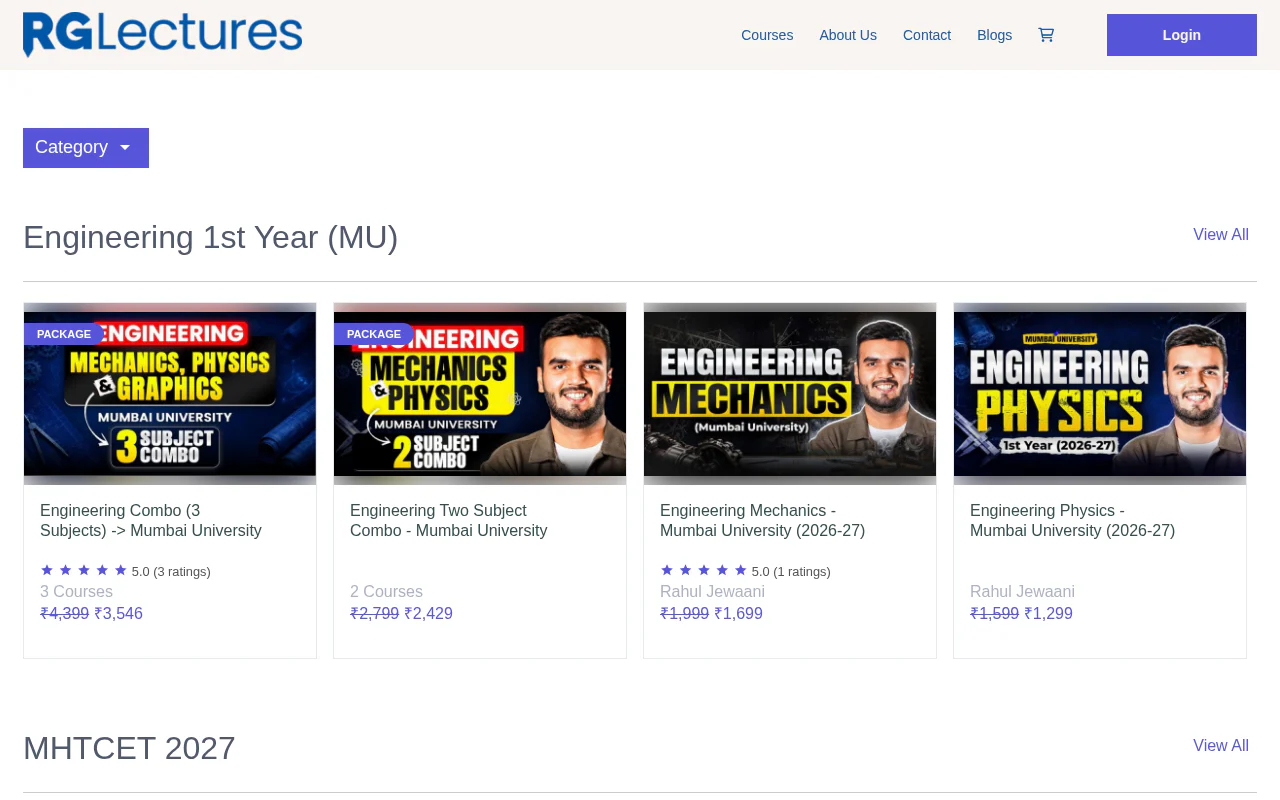
Hindi video lectures with notes for MU and SPPU first-year physics
- Type
- Video lectures
- Named by
- Built for MU and SPPU
- Covers
- Class 12 basics and the syllabus
- Role
- Main course
One course carries both the basics and the syllabus. Our lectures start from the base, are followed by notes, and are aligned to the university curriculum. Keep the textbook beside them for reference and extra practice on the numericals.
Strengths
- Built around the MU and SPPU first-year syllabi
- Self-paced, pre-recorded Hindi video lectures on a digital board, with study notes and email support
- Taught by Rahul Jewaani, known as RG Sir, with access valid until 30 June 2027
Avadhanulu, A Textbook of Engineering Physics
S Chand textbook, 2018 edition, 50 chapters across 1,440 pages
- Type
- Textbook
- Named by
- MU and SPPU
- Covers
- About 9 of 50 chapters for MU, 14 for SPPU
- Role
- Supporting textbook
It is on the textbook lists of both MU and SPPU. SPPU names all three authors, as the 2018 edition does, while MU cites a revised 2014 edition, so check the contents page of the copy you buy.
Strengths
- Named as a textbook by both MU and SPPU
- About 14 of 50 chapters match SPPU's five units by title
- Covers MU's six modules by title except for a few topics
Limitations
- Only about 9 of 50 chapters match the MU syllabus, so most of the book goes unused
- Qubits, solar cells and vector calculus are gaps to fill from other sources
Gaur and Gupta, Engineering Physics
Textbook named by MU, SPPU and Anna University
- Type
- Textbook
- Named by
- MU, SPPU, Anna University
- Covers
- Not chapter-mapped by us
- Role
- Alternative supporting textbook
It appears on 3 of the 4 syllabus lists we read, as a textbook for MU and SPPU and as a reference for Anna University. Keep it beside the lectures as an alternative to Avadhanulu.
Strengths
- Textbook in MU's NEP syllabus
- Textbook in SPPU's 2024 Pattern syllabus
- Reference in Anna University's PH25C01
Limitations
- VTU's syllabus does not name it, so it does not help there
Vasudeva, Modern Engineering Physics
S Chand textbook of 1,248 pages in seven parts, 2013 edition
- Type
- Textbook
- Named by
- MU only
- Covers
- Optics and Modern Physics parts
- Role
- Second textbook
A reasonable second textbook for MU only. Its Optics and Modern Physics parts are the natural places to look for MU's laser, fibre optics, thin-film and quantum modules; this is our part-level matching, so confirm each topic in the index.
Strengths
- Named by MU as a textbook, in the revised 2013 edition
- S Chand describes it as written "for the students of B.E./B.Tech. of all Technical Universities of India"
- Priced the same as Avadhanulu
Limitations
- Only MU names it among the four syllabi we read; SPPU, VTU and Anna University do not
- Parts titled Properties of Matter, Thermal Physics and Sound have no matching MU module title
Kittel, Introduction to Solid State Physics
Wiley India edition, 2018, 712 pages, nine chapters
- Type
- Reference
- Named by
- SPPU
- Covers
- About one of SPPU's five units
- Role
- Semiconductor extra
Worth buying for SPPU only if you want more on semiconductors, because it serves about one of SPPU's five units. Its Free Electron Fermi Gas, Energy Bands and Semiconductor Crystals chapters match SPPU's Unit IV topics by title.
Strengths
- Wiley India states it is written for undergraduate physics majors, with an emphasis on physics rather than formal mathematics
- Chapter titles match SPPU's Unit IV (Fermi level, band theory, semiconductors)
- Sold in rupees in the Wiley India edition
Limitations
- SPPU's units on photonics, quantum physics, wave optics and ultrasonics have no matching chapter title, so it serves about one unit
- At ₹1,099 it costs more than Avadhanulu's ₹999, and being written for physics majors it may run beyond a first-semester engineering course (our inference)
Griffiths, Introduction to Electrodynamics
Reference named by MU, VTU and Anna University
- Type
- Reference
- Named by
- MU, VTU, Anna University
- Covers
- Vector calculus, Gauss, Ampere, Faraday
- Role
- Electrodynamics reference
MU's own reference list points to Griffiths for the vector calculus and Gauss, Ampere and Faraday laws in the Electrodynamics module, which Avadhanulu does not title by chapter.
Strengths
- Listed in MU's references
- Named in the VTU and Anna University syllabi
- Fills the vector calculus gap in the MU chapter map
Limitations
- SPPU does not name it, so it is not needed for the SPPU units
- It is a reference for one MU module, not a full course text
How to choose
- 1
Check that your syllabus PDF shows the course code and year
Use a document from your university showing the code and pattern, such as BSC102 for MU's NEP or BSC-102-BES for SPPU's 2024 Pattern. SPPU's 2024 Pattern was revised with effect from academic year (AY) 2025-26, so an older PDF may be the wrong one. - 2
Copy the book list exactly
Write down each textbook and reference as the syllabus names it, including the edition where it gives one. MU, for example, names a 2014 revised edition of Avadhanulu. - 3
Match every module or unit to a chapter title
Open the contents page of the book you are considering. Each module or unit should have at least one chapter whose title matches. Write each module with none down as a gap. - 4
Look up each gap topic in the index
If a gap topic is missing from the index, you need a second source for it. A chapter title that does not name a topic does not prove the book skips it. - 5
Work out the real cost
Avadhanulu is ₹999 and Kittel's Wiley India edition is ₹1,099 as of November 2026, against ₹1,299 for each RG Lectures course. Add a second source for any gap you found.
Key takeaways
- Start with the RG Lectures Engineering Physics course for your university, built around the MU and SPPU first-year syllabi and priced at ₹1,299 each as of November 2026, then keep Avadhanulu or Gaur and Gupta beside it as the supporting textbook.
- Avadhanulu and Gaur and Gupta are both on the textbook lists for MU and SPPU, but other universities name different books, so match any book to your own syllabus before buying.
- In our title-level matching (comparing syllabus topics with chapter titles only; see the chapter tables below), about 9 of 50 chapters match the MU syllabus and about 14 match SPPU. Qubits, solar cells and vector calculus are the gaps to fill from other sources.
- SPPU's syllabus names numerical problems in all five units. Spend your practice time there.
Which engineering physics books and lectures should an MU or SPPU first-year student use?
Start with the RG Lectures Engineering Physics course for your university, then keep Avadhanulu or Gaur and Gupta beside it as the supporting textbook. Our courses for MU and SPPU are built around those first-year syllabi and cost ₹1,299 each as of November 2026 (list price ₹1,599).
We teach both the Mumbai University 2026-27 course and the Pune University 2026-27 course in Hindi, as self-paced, pre-recorded video lectures on a digital board, with study notes and email support. The instructor is Rahul Jewaani, known as RG Sir, and access is valid until 30 June 2027.
Both Avadhanulu and Gaur and Gupta appear as textbooks in the syllabi of MU, in its National Education Policy (NEP) syllabus, and SPPU, in its 2024 Pattern syllabus.
The 2018 edition of A Textbook of Engineering Physics by Avadhanulu, Kshirsagar and Arun Murthy is ₹999 on S Chand's page as of November 2026. It has 50 chapters across 1,440 pages. SPPU names all three authors, as that edition does. MU cites a revised 2014 edition, so check the contents page of the copy you buy.
MU also lists Vasudeva, Bhattacharya and Tandon, Rajendran, and Pradeep's nanotechnology text as textbooks. Its references are Beiser, Jenkins and White, Halliday and Resnick, and Griffiths' Introduction to Electrodynamics. SPPU's references include Ghatak's Optics, Kittel, and S.K. Kulkarni's nanotechnology book.
For the wider choice between a degree-only route, the National Programme on Technology Enhanced Learning (NPTEL) and a paid batch, see our Engineering Physics course guide. For Mechanics books, see Engineering Mechanics books.
Email support: ask@rglectures.com.
Why isn't one "standard" engineering physics book enough for every university?
Because universities name different books and different topics. We read the first-year Physics syllabi of four universities in November 2026: MU, SPPU, Visvesvaraya Technological University (VTU) and Anna University. We counted which books each names as a textbook or reference. This is our count of four syllabi, not a survey of India.
Avadhanulu appears on 2 of the 4 lists and Gaur and Gupta on 3. The content differs too. VTU's 2025 syllabus includes a Quantum Computing module, which a 50-chapter classic textbook does not title. Anna University's Applied Physics I opens with properties of matter such as elasticity and viscosity.
So a senior's book recommendation helps only if the senior studied your syllabus. For anyone outside MU and SPPU, run the check against your own university's list before you spend ₹999.
- Syllabus
- MU, Applied Physics BSC102, NEP syllabus
- Avadhanulu
- Textbook
- Gaur and Gupta
- Textbook
- Other books named
- Vasudeva, Rajendran, Beiser, Griffiths
- Syllabus
- SPPU FE 2024 Pattern, BSC-102-BES
- Avadhanulu
- Textbook
- Gaur and Gupta
- Textbook
- Other books named
- Ghatak, Kittel, Kulkarni, Serway and Jewett
- Syllabus
- VTU 1BPHYS102/202
- Avadhanulu
- Not named
- Gaur and Gupta
- Not named
- Other books named
- Sharma and Sharma, Kakani and Kakani, Pillai, Lala, Beiser, Griffiths
- Syllabus
- Anna University PH25C01
- Avadhanulu
- Not named
- Gaur and Gupta
- Reference
- Other books named
- Young and Freedman, Mathur, Griffiths, Silfvast
How do you check whether a book covers your syllabus?
Run four tests in order. Each has a clear pass or fail.
Does your syllabus PDF show the course code and year?
Pass if the document from your university shows the code and pattern, such as BSC102 for MU's NEP or BSC-102-BES for SPPU's 2024 Pattern. Fail if you only have a coaching summary or a senior's notes. SPPU's 2024 Pattern was revised with effect from academic year (AY) 2025-26, so an older PDF may be the wrong one.
Have you copied the book list exactly?
Pass if you have each textbook and reference as the syllabus names it, including the edition where it gives one. Fail if you are working from memory. MU, for example, names a 2014 revised edition of Avadhanulu.
Does every module or unit match a chapter title?
Open the contents page of the book you are considering. Pass if each module or unit has at least one chapter whose title matches. Fail for any module with none. Write each failure down as a gap.
Is each gap topic missing from the book's index?
Look up each gap topic in the index. If it is missing, you need a second source for it. A chapter title that does not name a topic does not prove the book skips it, which is why this test comes last.
How much of Avadhanulu's textbook does the MU Applied Physics syllabus need?
About 9 of 50 chapters: 6, 7, 8, 26, 27, 36, 37, 44 and 47. We mapped each of the six modules in MU's NEP Applied Physics syllabus to chapter titles in the S Chand contents list of the 2018 edition. This is title-level matching only, and chapter numbers may differ in the 2014 edition. Chapter 31 is not counted in the 9.
The six modules total 26 hours: 4 + 4 + 4 + 4 + 6 + 4. Nine chapters out of 50 is 18% of the book. For the vector calculus and Gauss, Ampere and Faraday laws in the Electrodynamics module, MU's own reference list points to Griffiths. Our pages on Gauss's law, Ampere's circuital law and Faraday's law cover the same ground.
- MU module (hours)
- I Lasers (4)
- Matching chapter titles
- 44 Lasers
- Gaps to check in the index
- Fibre laser; LiDAR, barcode reader, laser metal work
- MU module (hours)
- II Fibre Optics (4)
- Matching chapter titles
- 47 Optical Fibres
- Gaps to check in the index
- None found by title
- MU module (hours)
- III Interference in Thin Films (4)
- Matching chapter titles
- 8 Interference
- Gaps to check in the index
- None found by title
- MU module (hours)
- IV Electrodynamics (4)
- Matching chapter titles
- 6 Magnetostatics and Electrodynamics; 7 Electromagnetic Waves
- Gaps to check in the index
- Vector calculus (gradient, divergence, curl)
- MU module (hours)
- V Quantum Physics (6)
- Matching chapter titles
- 26 Matter Waves; 27 Quantum Mechanics
- Gaps to check in the index
- Qubit and quantum computing
- MU module (hours)
- VI Basics of Semiconductor Physics (4)
- Matching chapter titles
- 36 Band Theory of Solids; 37 Semiconductors
- Gaps to check in the index
- Check Chapter 31 Quantum Statistics for the Fermi-Dirac distribution
Which chapters of Avadhanulu match SPPU's BSC-102-BES units?
About 14 of 50: chapters 8, 10, 11, 14, 26, 27, 36, 37, 38, 42, 44, 46, 47 and 49, which is 28% of the book. We mapped the five units of SPPU's BSC-102-BES in the same title-level way. Each unit is 8 hours, 40 hours in all. Chapter 31 is not counted in the 14.
SPPU lists Kulkarni's nanotechnology book as a reference for Unit V. Treat it as your second source there.
Which topics need worked numericals beyond the book?
Practise the topics where the syllabus itself names numerical problems. SPPU does this in all five units: optical fibre parameters, de Broglie wavelength, energy of a particle in a rigid box, thin film and wedge, Malus' law, Hall effect, ultrasonics, and critical magnetic field. MU names them in Quantum Physics ("problems on de Broglie wavelength", "related numerical problems").
A textbook explains each of these. It does not drill them. From our teaching, these are the ones to work through until the steps feel automatic:
- De Broglie wavelength and particle in a box: on both lists. Our de Broglie wavelength formula page shows which form fits which question.
- Numerical aperture and acceptance angle: both syllabi list numerical aperture. See numerical aperture of optical fibre.
- Thin films and Newton's rings: MU lists Newton's rings, and SPPU lists thin film and wedge problems. See Newton's rings.
- Hall effect (SPPU): the Hall effect glossary entry covers the definition. Practise the derivation, since SPPU asks for it.
- SPPU unit
- I Fundamentals of Photonics
- Matching chapter titles
- 44 Lasers; 46 Holography; 47 Optical Fibres
- Gaps to check in the index
- None found by title
- SPPU unit
- II Quantum Physics
- Matching chapter titles
- 26 Matter Waves; 27 Quantum Mechanics
- Gaps to check in the index
- Quantum computing, qubit
- SPPU unit
- III Wave Optics
- Matching chapter titles
- 8 Interference; 10 Polarization; 11 Double Refraction and Optical Activity
- Gaps to check in the index
- None found by title
- SPPU unit
- IV Semiconductor Physics and Ultrasonics
- Matching chapter titles
- 36 Band Theory of Solids; 37 Semiconductors; 38 Solid Stage Diodes; 14 Ultrasonics
- Gaps to check in the index
- Solar cell; Hall voltage derivation
- SPPU unit
- V Nanoparticles and Superconductivity
- Matching chapter titles
- 49 Nanotechnology; 42 Superconductors
- Gaps to check in the index
- Check the index against SPPU's listed synthesis methods
How we built this list
We considered the textbooks and references named in the first-year Physics syllabi of four universities (MU, SPPU, VTU and Anna University), read in November 2026, plus the RG Lectures courses for MU and SPPU. Books were included if a syllabus names them and they are aimed at first-year engineering students. Entries are ranked by how closely they fit the MU and SPPU first-year syllabi, using title-level matching of chapters to modules and units, as of November 2026. RG Lectures is one of the companies listed.
This page is published by Rg lectures. If anything here is out of date, tell us and we will correct it.
Sources
- 1.University of Mumbai NEP syllabus, Applied Physics BSC102 (a college's copy of the syllabus)
- 2.Savitribai Phule Pune University FE 2024 Pattern syllabus, BSC-102-BES (a college's copy of the syllabus)
- 3.Visvesvaraya Technological University, Quantum Physics and Applications 1BPHYS102/202
- 4.Anna University, Regulation 2025 B.E. Mechanical Engineering, PH25C01 Applied Physics I
- 5.S Chand Publishing, A Textbook of Engineering Physics (chapters, pages, price)
- 6.S Chand Publishing, Modern Engneering Physics by A S Vasudeva (edition, pages, price, parts)
- 7.Wiley India, Kittel's Introduction to Solid State Physics, Wiley India Edition (price, pages, chapters, audience)
- 8.RG Lectures, Engineering Physics, Mumbai University 2026-27
- 9.RG Lectures, Engineering Physics, Pune University 2026-27