Surface Tension Explained Simply: Capillary Rise, Angle of Contact and MHT-CET Questions
Surface tension is the force per unit length along a liquid surface, T = F/L, in N/m. Capillary rise follows h = 2T cosθ/(ρgr): an acute angle of contact means a rise, an obtuse angle a fall. Decide the sign first, then calculate.

By Rahul Jeewani, Founder · Updated 23 Oct 2026
Key takeaways
- Surface tension T is the tangential force per unit length on a liquid surface, T = F/L, measured in N/m. It also equals surface energy per unit area, T = W/ΔA, in J/m².
- Capillary rise follows h = 2T cosθ/(ρgr). An acute angle of contact means a rise, an obtuse angle means a fall. Decide the sign first.
- h ∝ 1/r, so convert a diameter or an area into a radius first. A tilted tube keeps the vertical height.
- A soap film has two surfaces: F = 2Tl and ΔA = 2lx. Missing the 2 halves or doubles the answer.
In this article
- 1Surface tension in one picture
- 2Cohesion, adhesion and the sphere of influence
- 3What is surface tension, and what are its formula, unit and dimensions?
- 4Surface tension as surface energy: T = W/ΔA
- 5What changes surface tension: temperature, impurities and soap?
- 6What is the angle of contact, and how does it decide rise or fall?
- 7What is the capillary rise formula?
- 8Predict the rise or fall before you calculate
- 9Force balance behind the formula
- 10What changes the height h in a capillary tube?
- 11Four MHT-CET-style questions: which slips do they test?
- 12Q1: Area reduced to one-third (radius or area?)
- 13Q2: A capillary tube on the Moon
- 14Q3: Three liquids, same rise (which angle is larger?)
- 15Q4: Expanding a soap film (the two-surfaces factor)
- 16Which surface tension formulas and checks should you revise before the MHT-CET?
- 17What comes next after surface tension?
- 18Frequently asked questions
Surface tension is why a needle floats, why soapy water soaks into cloth and why water climbs a thin glass tube. According to the International Association for the Properties of Water and Steam (IAPWS) Release R1-76(2014), water has a surface tension of 72.74 mN/m at 20 °C.
In the Maharashtra Health and Technical Common Entrance Test (MHT-CET), the formulas for this topic are short. The marks go on slips. We use one term throughout: capillary rise, meaning the rise or fall of a liquid in a narrow tube.
Four slips are worth learning first: using an area as a radius, dividing by the Moon's g ratio instead of multiplying, reading a larger cosθ as a larger angle, and counting one surface on a soap film instead of two.
Each one is solved below with original numbers, a short solution and the exact slip to avoid. Pehle sign, phir number: decide whether the liquid rises or falls, then calculate.
Surface tension in one picture
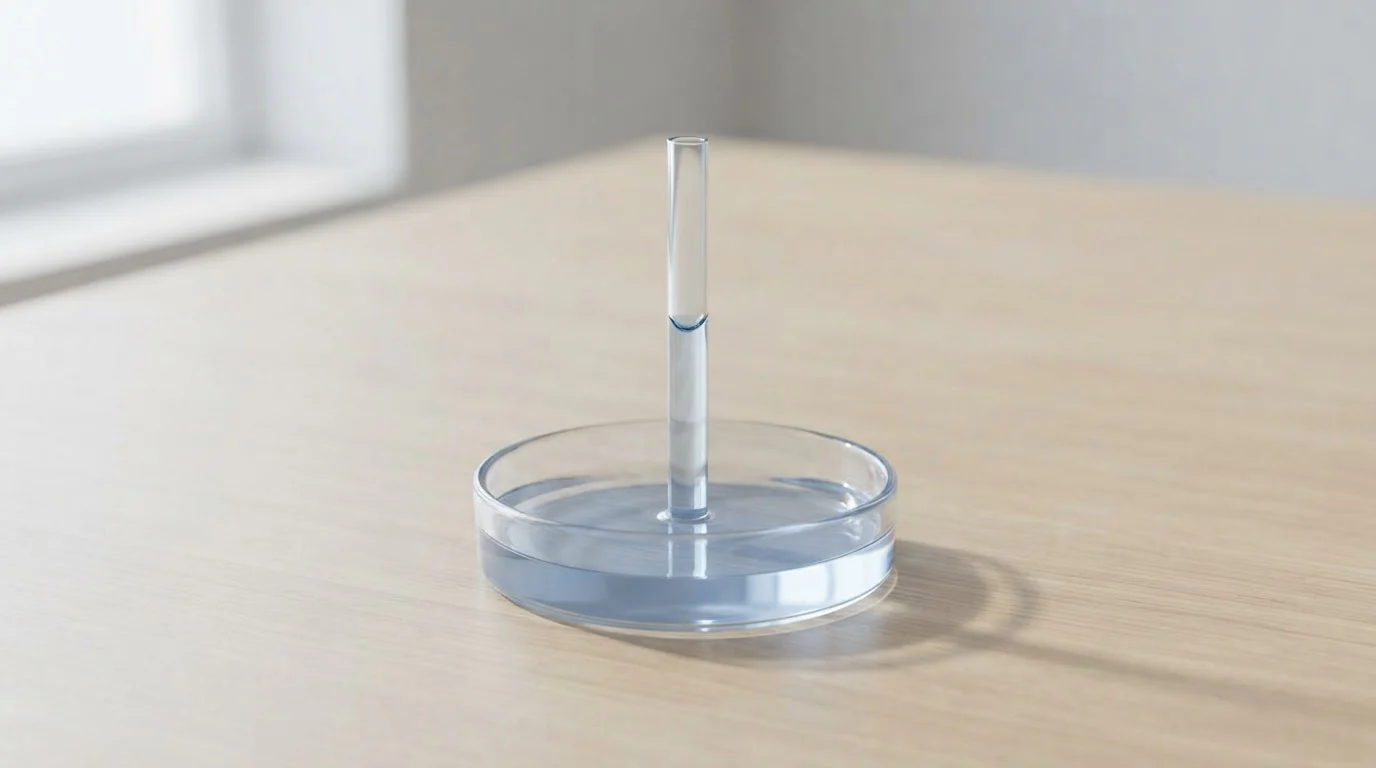
A liquid surface behaves like a stretched elastic film. Molecules in the surface layer are pulled inward by their neighbours, so the surface shrinks to the smallest area it can and pulls along its edge. That pull per unit length is surface tension, and it acts tangentially to the free surface.
Which class is this? In Maharashtra the chapter, Mechanical Properties of Fluids, belongs to Standard XII (Std XII, the Class 12 year) and is Chapter 2 of the Balbharati Std XII Physics textbook. In Central Board of Secondary Education (CBSE) schools it is Class 11, NCERT Chapter 9, so CBSE readers can use our CBSE Class 11 physics chapters alongside. As of October 2026, the State Common Entrance Test Cell (CET Cell), which sets MHT-CET, lists the whole Std XII syllabus plus a named list of Std XI chapters, with about 20% Std XI and 80% Std XII weightage overall (page 1 of the CET Cell syllabus PDF). That split is by class, not chapter; our MHT-CET Physics syllabus guide explains it.
Cohesion, adhesion and the sphere of influence
Cohesion is attraction between molecules of the same liquid. Adhesion is attraction between different substances, such as water and glass. A molecule feels others only within its sphere of influence. Deep inside the liquid the pull is equal in all directions. In the surface film there are fewer liquid neighbours above than below, so the net pull is inward (Balbharati, section 2.4). The balance of adhesion and cohesion also sets the meniscus shape.
What is surface tension, and what are its formula, unit and dimensions?
Surface tension T is the tangential force acting per unit length on an imaginary line drawn on a liquid's free surface, so T = F/L. Its SI (International System of Units) unit is N/m, which equals J/m². Its dimensions are [M L⁰ T⁻²]. Older books use dyne/cm: 1 N/m is 1000 dyne/cm.
In a question, use the T the question gives and say so; do not swap in the textbook value for water. A quick units and dimensions check confirms the form: N/m reduces to kg s⁻², with no length left in it.
Surface tension as surface energy: T = W/ΔA
Stretching a surface needs work, stored as surface energy. Take a wire frame holding a soap film, with a sliding wire of length l. The film has two surfaces, so the inward force on the wire is F = 2Tl. Pulling the wire out slowly through a distance x, at constant temperature, does work W = F·x = T(2lx) = T·ΔA, where ΔA = 2lx is the increase in the area of both surfaces (Balbharati, section 2.4.2). So T = W/ΔA, in J/m². Excess pressure inside drops and bubbles is a separate derivation, not covered here.
What changes surface tension: temperature, impurities and soap?
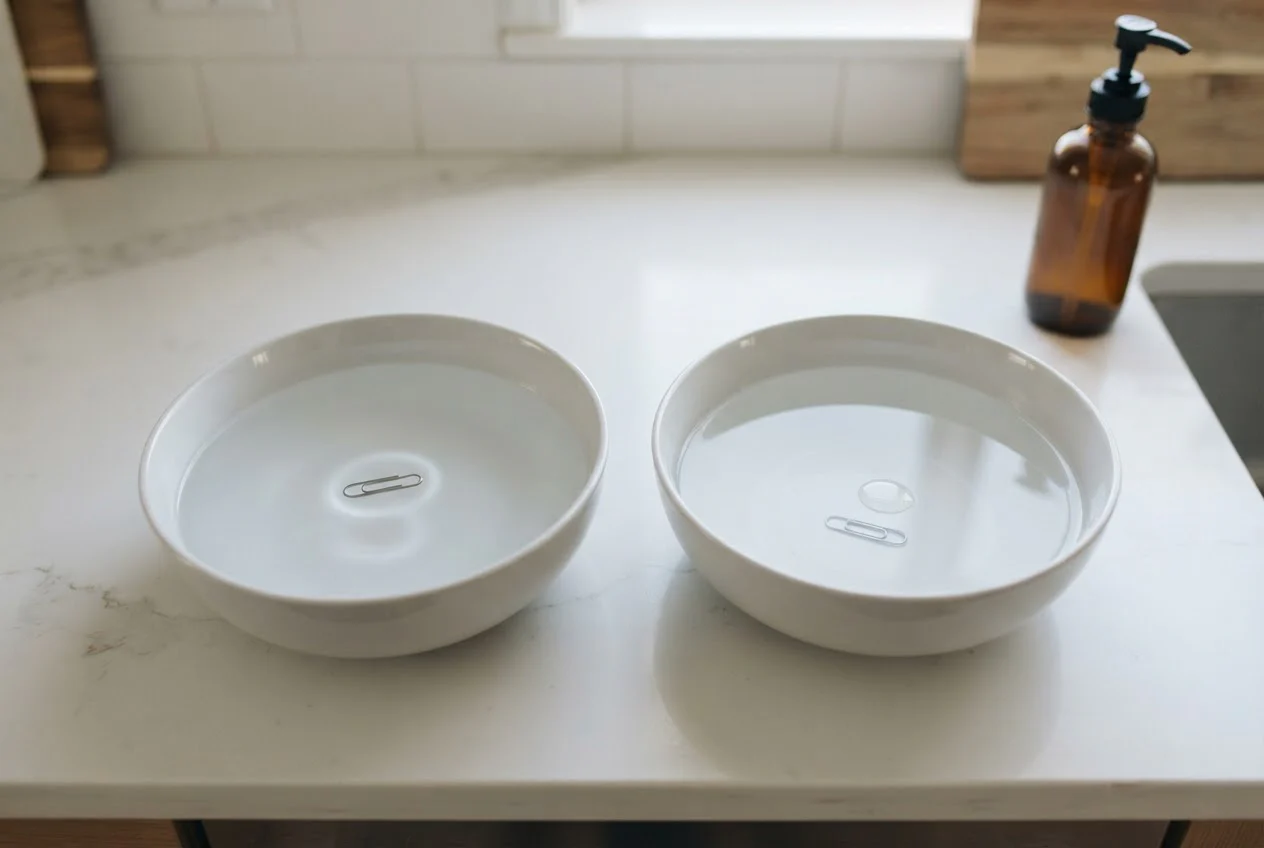
Temperature is the most predictable: surface tension falls as a liquid gets hotter. Impurities act both ways. Salt raises the surface tension of water, while phenol, detergent and insoluble impurities lower it. Soap is the standard example because it lowers T enough for water to soak into small pores.
| Temperature of water | Surface tension (mN/m) |
|---|---|
| 0.01 °C (triple point) | 75.64 |
| 20 °C | 72.74 |
| 100 °C | 58.92 |
Source: IAPWS Release R1-76(2014), Table 1, recommended values. Between 0.01 °C and 100 °C the value falls by 16.72 mN/m, about 22.1%. Balbharati (section 2.4.4) states the temperature and impurity effects, and the USGS notes that soaps and detergents lower surface tension so water soaks into pores. Balbharati's Table 2.1 lists a soap solution at 0.025 N/m at 20 °C, roughly a third of water's value.
What is the angle of contact, and how does it decide rise or fall?
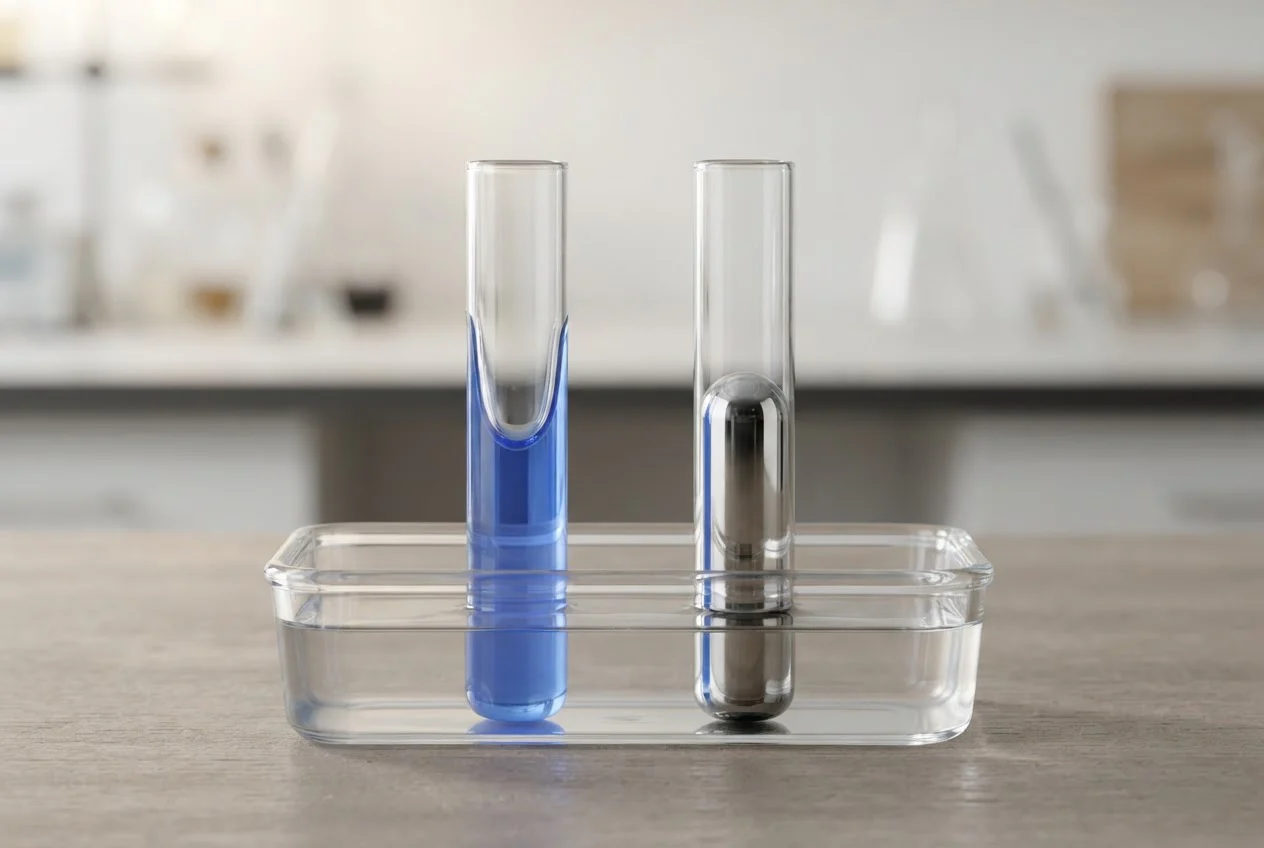
The angle of contact is the angle between the tangent to the liquid surface and the solid surface at the point of contact, measured inside the liquid. An acute angle means the liquid wets the solid, the meniscus is concave and the liquid rises. An obtuse angle means a convex meniscus, and the liquid is pushed down.
| Pair | Angle of contact | Meniscus | In a capillary tube |
|---|---|---|---|
| Water and clean glass | About 0° (Balbharati, section 2.4.3) | Concave | Rises, cosθ ≈ 1 |
| Mercury and glass | About 140° (NCERT) | Convex | Falls, cosθ is negative |
At exactly 90°, cosθ = 0, the surface stays flat and h = 0.
What is the capillary rise formula?
For a tube of radius r dipped in a liquid of density ρ and surface tension T, with angle of contact θ, the height is h = 2T cosθ/(ρgr). A positive h is a rise. A negative h, which comes from a negative cosθ, is a fall below the outside level. Use the tube's radius, in metres.
Predict the rise or fall before you calculate
Ask whether θ is acute or obtuse: acute means expect a rise, obtuse a fall, and 90° no movement. Only then substitute. A negative h for water in clean glass means an error before the arithmetic.
Force balance behind the formula
Along the circle of contact, of length 2πr, the upward part of the surface tension force is 2πrT cosθ. It holds up the raised column, of weight πr²hρg, ignoring the small meniscus volume. Equating gives h = 2T cosθ/(ρgr). The textbook reaches the same result through the pressure difference across the curved surface (Balbharati, section 2.4.7).
What changes the height h in a capillary tube?
In h = 2T cosθ/(ρgr), the height grows with T and cosθ and shrinks with ρ, g and r. Radius causes most mistakes, because data often arrives as a diameter or an area. Convert to radius first, then scale.
| Variable | Effect on h | Trap |
|---|---|---|
| Radius r | h ∝ 1/r, so half the radius doubles h | A diameter or an area is given, and r ∝ √A |
| Angle θ | h ∝ cosθ, and an obtuse angle gives a fall | A larger cosθ means a smaller angle |
| Density ρ | h ∝ 1/ρ | For the same rise, a denser liquid needs a larger cosθ |
| Gravity g | h ∝ 1/g, so on the Moon h is 6 times larger | Multiply by the ratio of g, never divide. A lift accelerating upward uses g + a |
| Surface tension T | h ∝ T, so hot water rises less | T falls as temperature rises |
| Tube tilt | The vertical height is unchanged, and the length along the tube is h/cosα, with α from the vertical | Using h as the length along the tube |
| Weightlessness | No finite equilibrium height | Do not substitute g = 0 |
Diameter slip. A tube of diameter 0.6 mm has r = 0.3 mm. With the example's T = 0.07 N/m, θ = 0°, g = 9.8 m/s² and ρ = 1000 kg/m³, h = 2 × 0.07 ÷ (1000 × 9.8 × 0.0003) = 0.0476 m = 4.76 cm. Using 0.6 mm as r gives 2.38 cm, exactly half.
Tilted tube. If the vertical rise is 4 cm and the tube is held at 60° to the vertical, the liquid travels 4 ÷ cos 60° = 8 cm along the tube.
Four MHT-CET-style questions: which slips do they test?
All four questions are original, and each tests one slip. Use the four-step numerical method for the working.
Q1: Area reduced to one-third (radius or area?)
Water rises 2.0 cm in a capillary tube. A tube of the same material with one-third the cross-sectional area replaces it. Find the new rise.
Solution: Area ∝ r², so the new radius is r/√3. Since h ∝ 1/r, h = 2.0 × √3 = 3.46 cm, about 3.5 cm.
Slip: Treating one-third as the ratio of radii gives 6.0 cm.
Q2: A capillary tube on the Moon
Water rises 2.5 cm in a capillary tube on Earth. The same tube and water are used on the Moon, where g is one-sixth of Earth's. Find the rise.
Solution: h ∝ 1/g, so a smaller g gives a larger h: 2.5 × 6 = 15 cm.
Slip: Dividing by 6 gives 0.42 cm.
Q3: Three liquids, same rise (which angle is larger?)
Liquids P, Q and R have densities 800, 1000 and 1200 kg/m³. Each has T = 0.05 N/m, and each rises 1.2 cm in a tube of radius 0.5 mm. Take g = 9.8 m/s² and arrange the angles of contact in increasing order.
Solution: From the formula, cosθ = hρgr/(2T). For the same rise, cosθ is proportional to density, so the denser liquid has the larger cosθ and the smaller angle. Numerically, cosθ = 0.470 for P, 0.588 for Q and 0.706 for R, giving θ = 61.9°, 54.0° and 45.1°. The order is θ_R < θ_Q < θ_P.
Slip: Reading the larger cosθ as the larger angle reverses the order.
Q4: Expanding a soap film (the two-surfaces factor)
A soap film on a wire frame is held by a sliding wire of length 8.0 cm. A force of 0.0048 N balances the film. Find T, then the work done in pulling the wire slowly a further 3.0 cm.
Solution: The film has two surfaces, so F = 2Tl and T = 0.0048 ÷ (2 × 0.080) = 0.030 N/m. The area increase is ΔA = 2 × 0.080 × 0.030 = 0.0048 m², so W = TΔA = 0.030 × 0.0048 = 1.44 × 10⁻⁴ J. Check: F·x = 0.0048 × 0.030 gives the same value.
Slip: Using ΔA = lx counts one surface and gives 7.2 × 10⁻⁵ J, half the right answer.
If you would rather work through this chapter with a teacher, see our MHT-CET Physics batches and check each batch page for what it covers.
Which surface tension formulas and checks should you revise before the MHT-CET?
Revise five formulas: T = F/L, T = W/ΔA, F = 2Tl for a soap film, h = 2T cosθ/(ρgr), and length along a tilted tube = h/cosα. Add one rule: fix the sign of cosθ, which tells you rise or fall, before any number goes in.
| Formula | Use | Check before you substitute |
|---|---|---|
| T = F/L | Force on a line of length L | One surface or two? |
| T = W/ΔA | Work to enlarge a surface | ΔA counts every surface |
| F = 2Tl | Soap film on a frame | The factor 2 |
| h = 2T cosθ/(ρgr) | Capillary rise | Sign of cosθ, and r not d |
| Length = h/cosα | Tilted tube | α from the vertical |
Practise previous years' questions (PYQ) with our chapter-wise PYQ plan.
What comes next after surface tension?
This page stops at surface tension and capillary rise. Drops, bubbles, viscosity and Bernoulli’s principle complete the chapter and need their own revision.
Before your next practice set, run three checks: fix the sign of cosθ first, convert every diameter or area to a radius, and count both surfaces of a soap film. These three habits cover all four slips solved above.
Chapter weightage is historical, not official, so do not plan around a figure. The guide to chapter-wise weightage shows how to read any chapter figure you meet. Pair this page with regular PYQ practice, and revisit the three checks above before every test. Padhna Aasaan Hai.
Learn MHT-CET Physics live with RG Lectures
Frequently asked questions
Sources
- 1.Release on Surface Tension of Ordinary Water Substance, R1-76(2014)
- 2.Release on Surface Tension of Ordinary Water Substance, Table 1 (PDF)
- 3.Std XII Physics textbook, Chapter 2
- 4.Syllabus for Technical courses 2026 (PDF)
- 5.Class 11 Physics, Chapter 9: Mechanical Properties of Fluids (PDF)
- 6.Surface tension and water